 Trail Bound Paws
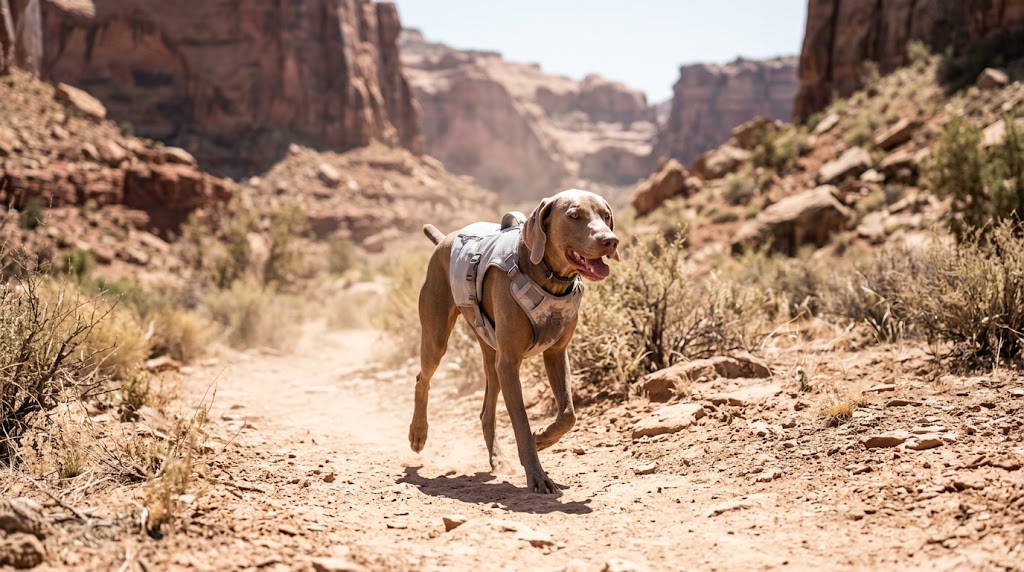
The physics of evaporative cooling
The vast majority of canine cooling vests use evaporative cooling technology, typically constructed with a three-layer textile system: an outer mesh shell that facilitates evaporation, an absorbent middle core that retains water, and a comfortable inner lining that transfers the cooling effect toward the body.
Evaporation is an endothermic reaction. Liquid water stored in the vest's middle core absorbs heat energy from the dog's body. As the water molecules reach a high enough energy state, they transition from liquid to gas. This phase change consumes latent heat, extracting thermal energy from the dog's coat and circulating blood vessels, creating a cooling gradient.
The relative humidity barrier
Product tags frequently promise "continuous cooling for hours," but they rarely mention the single environmental variable that governs evaporation: ambient relative humidity.
- Arid or low-humidity climates (below 45%): The ambient air has low vapor pressure, allowing water to evaporate rapidly. Evaporative cooling vests work exceptionally well, lowering surface coat temperatures significantly.
- Humid climates (above 75%): When the air is saturated with moisture, the evaporation rate plummets toward zero. If the water cannot evaporate, the vest stops cooling. Worse, the heavy, saturated garment traps metabolic body heat against the dog's torso, acting as thermal insulation and accelerating heat stress.
Bottom line: Do not use evaporative vests in humid summer weather. A non-evaporating wet vest acts as a hot blanket.
Evaporative vests vs. phase change packs
- Evaporative textile vests: Lightweight when dry, easily reactivated at trail streams. But completely dependent on dry air and wind; they fail in humid conditions.
- Phase change material (PCM) or ice packs: Pre-frozen chemical inserts maintain a set temperature (typically 14°C / 58°F) until fully melted. They operate independently of ambient humidity and provide direct conductive cooling. But they are heavy to carry, rigid packs can impede shoulder movement, and they are difficult to recharge on backcountry trails.
When using either approach, the vest should not interfere with your dog's harness fit. The Ruffwear Hi & Light is slim enough to layer under most cooling vests without adding bulk that restricts movement.
Coat type matters: double coats vs. single coats
- Single-coated or short-haired breeds (pointers, boxers, vizslas): Thin hair layer with skin exposed to direct radiant solar heat. Cooling vests provide direct conductive transfer between the cold lining and the skin surface. High benefit: protects thin skin from solar radiation while providing instant convective cooling.
- Double-coated breeds (huskies, golden retrievers, shepherds): Dense undercoat topped with water-repellent guard hairs acting as natural thermal insulation. The thick hair layer acts as a barrier, preventing the cool moisture from reaching the skin. Mixed or poor results: wetting the outer coat can create an insulating humid layer beneath the fur, trapping heat close to the skin.
Four mandatory safety rules for trail cooling vests
- Monitor moisture levels continuously: An evaporative vest only cools while it is wet. The moment the vest dries out on an arid trail, it becomes a dry fabric insulator that traps heat. Check every 30 to 45 minutes and re-saturate.
- Prioritize chest and belly coverage: The greatest concentration of superficial blood vessels is located along the ventral chest and groin. Ensure the vest fits snugly around the deep sternum rather than merely draping across the back. A Ruffwear Front Range Harness worn underneath keeps the vest positioned correctly over the chest.
- Carry extra water specifically for the vest: Never divert your dog's drinking water to recharge a cooling vest if trail water sources are dry or scarce. Recharging can consume 16 to 32 oz of water per cycle.
- Never rely on a vest to hike in extreme heat: A cooling vest is a supplemental comfort tool, not a life-support system. It cannot prevent heat stroke if you hike during peak midday sun in temperatures exceeding 30°C (86°F).
The research verdict
Do dogs need cooling vests for summer hiking? Only under specific environmental and physiological conditions. In dry, arid, or high-altitude environments with low humidity, an evaporative cooling vest is a valuable tool for short-haired breeds exposed to direct sun. However, in humid conditions, evaporative vests fail and act like insulating wet blankets that accelerate heat retention.
For double-coated breeds or humid forest treks, proper trail timing (hiking at dawn), frequent shade breaks, unlimited cool drinking water, and keeping trail mileage moderate remain far safer strategies than relying on wearable cooling gear.
Trail Bound Paws tip: Before buying a cooling vest, check the average summer humidity for your hiking region. If it regularly exceeds 70%, an evaporative vest will underperform. Focus instead on trail timing, shade management, and carrying extra drinking water.
To compare lightweight summer vests, UV-reflective coats, and thermal-regulating trail gear, visit our weather protection guide.