 Trail Bound Paws
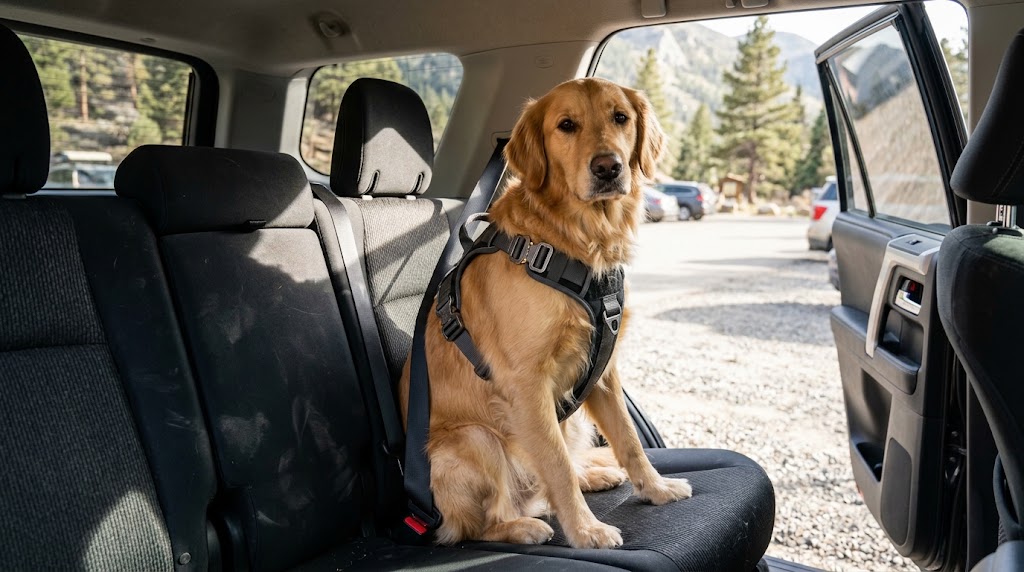
The physics of an unrestrained canine in a collision
In a 30 mph collision, an unrestrained occupant continues traveling forward at 30 mph until striking a rigid barrier. A 60 lb dog experiencing a 30 mph impact generates approximately 1,800 lbs of dynamic projectile force. This force shatters automotive glass, causes severe trauma to human passengers seated ahead, and delivers fatal kinetic shock to the dog.
A vehicle dog harness must fulfill two separate mechanical tasks:
- Prevent ejection and projectile flight: Keep the dog within the seat perimeter and prevent impact with the vehicle windshield or front seats.
- Disperse shock loads across strong skeletal structures: Distribute severe deceleration forces safely across the dog's chest without crushing the ribcage, rupturing internal organs, or strangling the trachea.
See our car safety and travel guide for our full evaluations of travel restraint systems.
"Crash-tested" vs. "crash-certified"
There is no mandatory government standard (such as NHTSA or FMVSS in the United States) governing pet travel restraint systems. Consequently, the term "crash-tested" is an unregulated marketing phrase. A product stamped "crash-tested" may have failed the test catastrophically, yet manufacturers can still print the phrase on the box because the test was technically conducted.
- Static tensile pull test: Harness anchored to a bench; a hydraulic ram pulls webbing in a single linear vector until breaking. Tests only raw tensile break-strengths; ignores real kinetic rotation. Zero mph.
- Self-conducted dynamic sled test: Harness placed on a dummy on a private sled, propelled into a barrier at variable speeds (often 20 to 25 mph). Manufacturer decides pass/fail criteria. Often unreleased data.
- Independent certified dynamic test (CPS Standard): Harness mounted on an instrumented canine crash dummy, tested on an automotive sled rig at a standardized 30 mph. Products must maintain full structural integrity and keep the dummy on the seat bench to earn certification.
The Kurgo Impact Dog Car Harness has undergone independent crash testing, making it one of the more transparent options on the market.
Three failure modes that sled tests reveal
When non-certified walking harnesses or budget travel vests undergo independent 30 mph sled testing, they typically fail in one of three ways:
- Hardware shear or buckle shatter: Plastic side-release buckles or stamped zinc D-rings snap instantly under initial dynamic impact shock. The dog becomes a free-flying projectile inside the cabin.
- Webbing extension and torso ejection: Webbing elongates or friction adjusters slip, allowing the dog's body to slip out of the neck hole mid-impact. Total restraint failure.
- Severe rotational flipping: Harness attaches via a long rear tether, allowing the dog's center of mass to pitch forward and spin 180 degrees. Causes severe hyper-extension of the lumbar spine, pelvic fractures, and soft-tissue strangulation.
Four engineering features of legitimate crash-tested harnesses
- Buckle hardware: All-metal nested interlocking buckles (modeled after rock climbing and worker fall-protection harnesses), not plastic side-squeeze buckles.
- Webbing construction: Automotive-grade seatbelt webbing (continuous loop design that cradles the ribcage), not standard nylon craft webbing. The Kurgo Enhanced Strength Dog Car Harness uses steel nesting buckles and automotive-grade webbing.
- Chest plate engineering: Broad, padded sternum shield that disperses thousands of pounds of impact force across the breastbone, not a narrow unpadded strap.
- Tether integration: Direct seatbelt threading path or short, drop-forged steel carabiners designed to keep the dog flush to the seat bench, not a long flexible nylon lead.
Why tether length matters
Many commercial dog restraints rely on an extension tether that clicks into the seatbelt receptacle on one end and clips to the back of the harness on the other. If a dog sits on a 15-inch tether, the dog accelerates forward 15 inches into empty space before the tether tightens. When the tether abruptly catches, it delivers an enormous dynamic shock load, similar to a rock climber falling on a slack static rope.
For maximum crash protection, the harness must either thread directly through the car's existing three-point seatbelt through dedicated dorsal loops on the back of the harness chassis, or use an ultra-short, load-rated tether that keeps the dog's back resting nearly flush against the vehicle seatback.
Harness vs. crate for trail travel
- Crash-tested harness: Best for backseat passengers, dogs that ride calmly, and compact cars with limited cargo space. Restricts the dog to sitting or lying flat.
- Crash-tested crate (rotomolded or aluminum): Best for SUV cargo areas, working dogs, active dogs that move around, and muddy dogs after a hike. Requires substantial cargo space and must be strapped down using heavy-duty load-rated tie-down straps.
- Unsecured or standard walking harness: Never acceptable for vehicle transit. Zero dynamic impact protection; dangerous projectile hazard for all cabin occupants.
The research verdict
The phrase "crash-tested" is meaningless without documented, transparent test protocols. When shopping for travel gear, ignore generic manufacturer claims and verify independent dynamic sled test data conducted at 30 mph with canine crash dummies. Look for all-metal nested hardware, continuous-loop automotive webbing, and direct seatbelt threading paths that eliminate slack distance.
Trail Bound Paws tip: Before buying a car harness, check whether the manufacturer publishes their full crash test video and data. If they do not, the "crash-tested" label on the box is marketing, not a safety guarantee.
To compare independent crash test results, sizing, and vehicle compatibility ratings, explore our car safety and travel guide.