 Trail Bound Paws
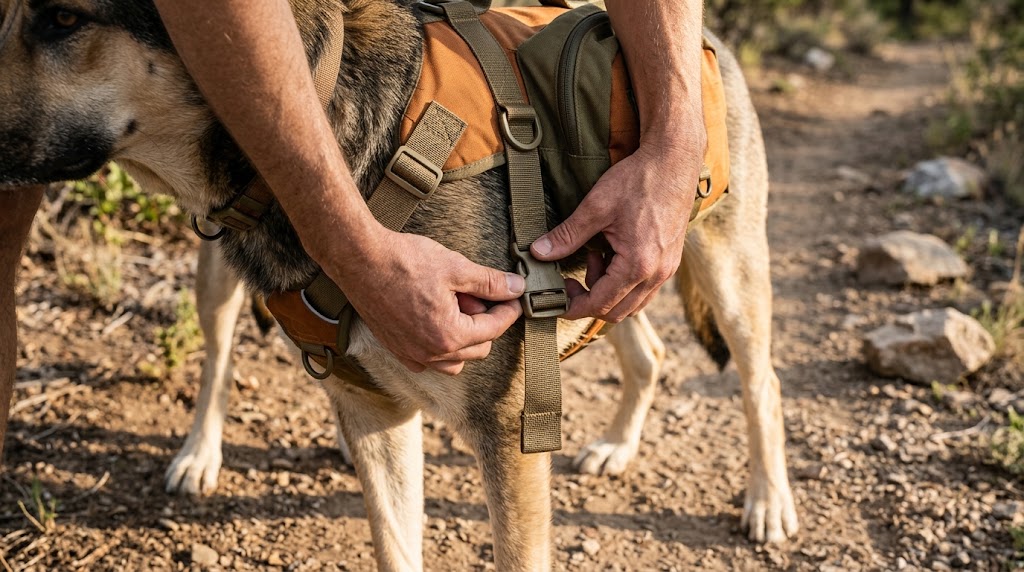
Four root causes of saddlebag shifting
When a pack leans heavily to the left or right, handlers often assume a strap has slipped. In reality, shifting is almost always driven by mechanical and physical imbalances:
- Asymmetric mass distribution: Even a 3 to 4 oz weight discrepancy causes the heavier side to drag the pack down within 10 minutes of walking.
- Loose compression strapping: Uncompressed contents bounce and slide inside the pannier pocket with each stride, shifting to the outer edge and tilting the harness chassis.
- Chassis webbing under-tension: Girth straps left too loose out of an unfounded fear of constricting breathing allow the harness chassis to roll freely over the spine.
- Incompatible harness cut: A harness chassis that is too short or lacks a stabilizing secondary belly strap causes the entire pack to pivot like a seesaw over the withers.
The Ruffwear Approach Pack addresses several of these issues with its integrated compression straps and multi-point harness chassis. See our dog backpacks guide for full comparisons.
Compression straps and internal lever arms
Manufacturer spec sheets routinely list total internal volume (e.g., "12 Liters of Storage") but frequently omit how that volume is managed when the pack is not completely full.
If a pannier is loosely packed, items settle at the bottom and outside edge of the saddlebag. This moves the center of mass away from the dog's spine, creating a longer lever arm. Every step amplifies this rotational torque, pulling the pack sideways and causing the inner fabric to rub hard against the dog's ribcage.
- Budget or basic panniers: Fixed bag shape with no compression system. Causes significant load bounce, lateral shifts, and high friction points across the ribs.
- Integrated compression systems: External cinch straps or internal pull-cords that pin the bag flat against the dog's flank. Keeps items close to center of mass, eliminating cargo shift and lateral roll.
- Removable saddlebag systems: Modular panniers that unclip from an independent, fully padded Y-harness chassis. Allows the harness to remain custom-fitted while bags are balanced or removed at rest stops. The OneTigris Dog Saddlebag uses this modular approach.
Step-by-step fitting protocol to eliminate chafing
- Fit the base harness chassis: Adjust the front neck and sternum straps before attaching or loading the panniers. Ensure the front Y-junction sits centered over the breastbone with zero pressure on lateral shoulder bones.
- Position the primary girth strap: Adjust ventral strap length to keep the main ribcage strap well back from the forelegs. Maintain a strict 2 to 4 finger buffer behind the elbow to prevent armpit chafing during leg swing.
- Secure the secondary belly strap: Cinch the rear abdominal strap (present on technical multi-strap packs) snugly over the rear ribcage, never over soft abdominal organs, to prevent lateral tail-wag sway.
- Calibrate symmetric weight: Use a digital luggage or kitchen scale to weigh both loaded panniers before setting out. Ensure both sides are balanced to within 1 ounce (28 grams) of each other.
- Engage compression straps: Cinch all external compression webbing until the panniers sit tight against the harness. Squeeze dead space out of the bags so contents cannot migrate outward or downward.
Four common chafing zones and how to fix them
Inspect your dog's skin at rest breaks. If you notice localized heat, red skin, or broken fur, apply these immediate adjustments:
- Behind the elbows (axillary crease): The forward girth strap is adjusted too far forward. Lengthen the lower chest strap running between the front legs to push the girth strap back onto the true ribcage.
- Along the sternum (breastbone): The chest plate is shifting or loose, creating abrasive friction as the dog trots. Shorten the neck straps to pull the breastplate securely against the manubrium.
- Across the top spine (withers): The saddlebags are overloaded or sagging downward, causing the connecting fabric bridge to pull taut across the dorsal vertebrae. Reduce total pack weight immediately.
- Lower rib flanks: The pack is shifting side to side, causing the textured underside of the pannier to scrub against the coat. Rebalance the cargo weight symmetrically and tighten the compression straps.
The research verdict
Preventing pack rub and saddlebag sway requires a combination of proper anatomical chassis placement, balanced cargo weight, and active volume compression. A pack should never ride loosely on a dog's back like a set of hanging saddle baskets. When fitted properly, the chassis moves as an integrated extension of the dog's ribcage, preserving joint freedom and protecting skin health over demanding backcountry miles.
Trail Bound Paws tip: Pack soft, flat items (like a collapsible bowl or poop bags) against the dog's body side of each pannier, and harder, denser items (water bottles, treats) toward the outer wall. This creates a padded buffer between the rigid cargo and the dog's ribcage and reduces friction hot spots.
To compare packs featuring multi-strap harness chassis and built-in load compression, visit our dog backpacks guide.