 Trail Bound Paws
A note on our research approach
At Trail Bound Paws, we do not present fabricated hands-on field trials. Our analysis synthesizes published veterinary biomechanics research, manufacturer hardware specifications, material safety data, and aggregated field reports from long-distance trail handlers. For our curated product evaluations and size breakdowns, review our complete paw protection and dog boots guide.
Understanding paw wax: barrier vs. structural shield
Paw wax formulas (such as Musher's Secret or equivalent beeswax and carnauba blends) are dense, semi-solid topical ointments. They absorb partially into the outer stratum corneum of the pad while leaving a breathable, water-resistant film across the surface.
How it works
- Hydrophobic sealing: The lipid-heavy base prevents water, melting snow, and slush from penetrating pad tissue.
- Anti-clumping action: Wax applied between the toes inhibits ice balls from forming in the interdigital fur, a common source of trail lameness in sub-zero conditions.
- Keratin conditioning: Regular application maintains tissue elasticity, helping prevent micro-fissures and dry cracking caused by arid climates or abrasive grit.
- Preserved proprioception: Because nothing encases the foot, your dog retains full sensory tactile feedback and natural paw splay on steep ascents.
Physical limitations
Paw wax creates a microscopic coating measured in microns. Consequently, it cannot provide structural defense:
- Zero puncture or laceration resistance: It cannot stop sharp shale, flint, broken glass, or thorn punctures.
- Zero thermal conduction insulation: Liquid wax cannot block conductive heat transfer from baking rock or desert sand.
- Rapid erosion: Dry sand, abrasive granite, and wet river crossings strip wax away quickly, requiring reapplication every few miles on demanding routes.
Understanding dog hiking boots: mechanical isolation
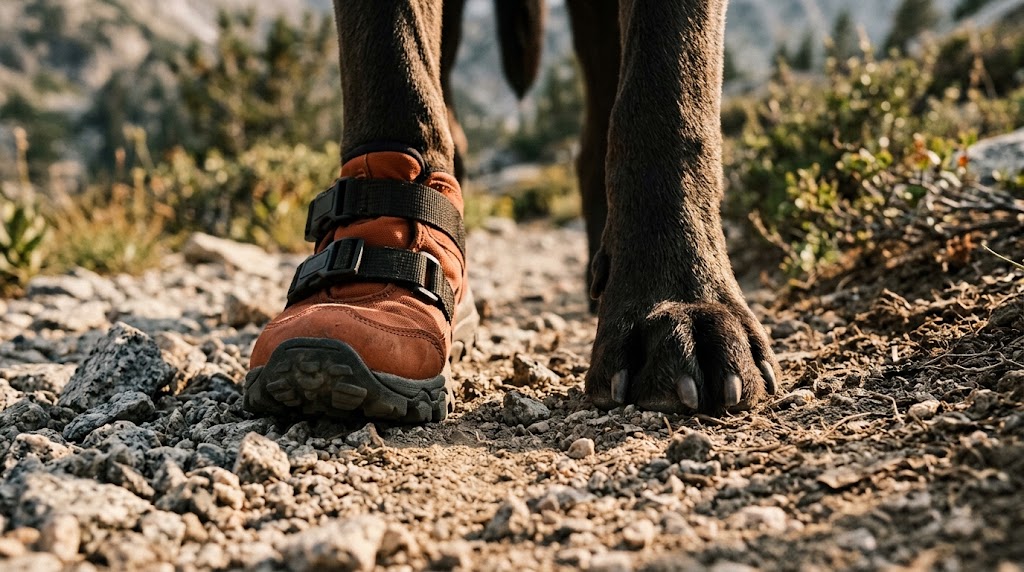
Dog hiking boots like the Ruffwear Grip Trex isolate the paw from the trail using molded rubber outsoles, reinforced fabrics (such as ballistic nylon or ripstop Cordura), and hook-and-loop closure systems.
How they work
- Mechanical shock and laceration defense: Thick lugged soles (often Vibram or molded synthetic rubber) prevent sharp scree, volcanic rock, and cacti from penetrating the pad tissue.
- Thermal insulation: A vulcanized rubber sole creates an air gap and solid physical barrier that insulates sensitive tissue from scorching sand or freezing ice.
- Wound protection: Boots keep existing pad abrasions, torn nails, or sutures clean and free from trail dirt.
Biomechanical tradeoffs
While boots offer substantial protection, they introduce physical compromises:
- Altered kinematics and proprioception: Encasing the paw alters natural digit splay during weight-bearing stance, which can affect balance on narrow ledges or technical scrambles.
- Heat trapping: Dogs dissipate heat partly through eccrine sweat glands located in their paw pads. A sealed, non-breathable boot traps moisture and heat during strenuous summer hikes.
- Chafing hazards: Friction between the boot collar, dewclaws, and carpal pads can cause chafing if the boot shifts or if trail grit gets inside.
Environmental showdown: what the specs don't tell you
Manufacturer specifications highlight water resistance, sole grip, and all-season versatility. However, real-world trail performance depends directly on the surface hazard.
Hot sand and rock (above 45°C / 113°F)
Wax: Fails immediately. Hydrocarbon and lipid waxes liquefy under direct surface heat and offer no thermal insulation against blistering.
Boots: Highly effective. Thick lugged outsoles block conductive heat transfer to the digital pads.
Verdict: Boots are essential for hot rock and desert trails. Wax is useless here.
Sharp scree, shale, and volcanic rock
Wax: Ineffective. Provides no defense against lateral shear or razor-sharp rock edges.
Boots: High defense. Vulcanized soles shield against lacerations and pad bruising.
Verdict: Boots are critical for scree fields and jagged alpine routes.
Packed snow and ice trails
Wax: Superior for light trekking. Eliminates ice-ball formation between toes without adding weight or causing gait restriction.
Boots: Mixed. Can cause friction rubs or slip on hard ice unless equipped with specialized winter rubber compounds.
Verdict: Wax wins for active snow runs; insulated boots are preferred for extended sub-zero treks or crusted ice.
Salted roads and chemical de-icers
Wax: Moderate protection. Forms a reliable barrier against chemical burns and salt irritation on short approaches.
Boots: Complete protection. Completely seals the paw from direct contact with caustic chemical de-icers.
Verdict: Tie. Wax works well for quick passes; boots provide an absolute barrier.
River crossings and mud
Wax: Washes off. Emulsifies and strips away within 15 to 30 minutes of sustained water exposure.
Boots: Functional with caveats. Maintains sole traction, but wet fabric can cause rubbing once saturated.
Verdict: Boots with drainage ports outperform wax on rocky riverbeds, though they must be dried after use.
Practical trail strategy: the hybrid approach
Experienced trail handlers rarely treat this as an all-or-nothing choice. Instead, they use a practical hybrid system:
- Pre-trip conditioning: Use paw wax at home several weeks before a trip to condition the pads and prevent dryness, rather than expecting it to serve as trail armor.
- Pack boots as essential safety gear: Even if your dog hikes comfortably bare-pawed, carry a set of four properly fitted boots in your pack. If a pad tears or the trail turns into jagged talus, a boot functions as an immediate, protective splint.
- Protect dewclaws: If using boots on rocky terrain, wrap the lower carpal joint and dewclaw with a layer of cohesive flexible bandage (vet wrap) or use specialized dog boot liners to prevent friction sores.
The decision checklist
To determine what your dog needs for the next hike, assess these three conditions:
- Is the ground too hot to touch with the back of your hand for 7 seconds? Use boots. Wax liquefies under thermal heat and will not prevent burns.
- Are you traversing sharp talus, broken granite, or cactus terrain? Use boots. Thin pad skin requires mechanical puncture protection.
- Are you hiking in snow with a dog prone to ice clumps between its toes? Use wax. A thorough application between the toes prevents ice buildup without the fit headaches of boots.
Trail Bound Paws tip: The smartest approach is to carry both. Apply paw wax before the hike for conditioning and light protection, and keep a set of boots in your pack as emergency backup. If conditions change mid-trail, you are covered either way.
For detailed product breakdowns, sizing instructions, and our research-backed recommendations for both boots and pad salves, visit our paw protection and dog boots guide.