 Trail Bound Paws
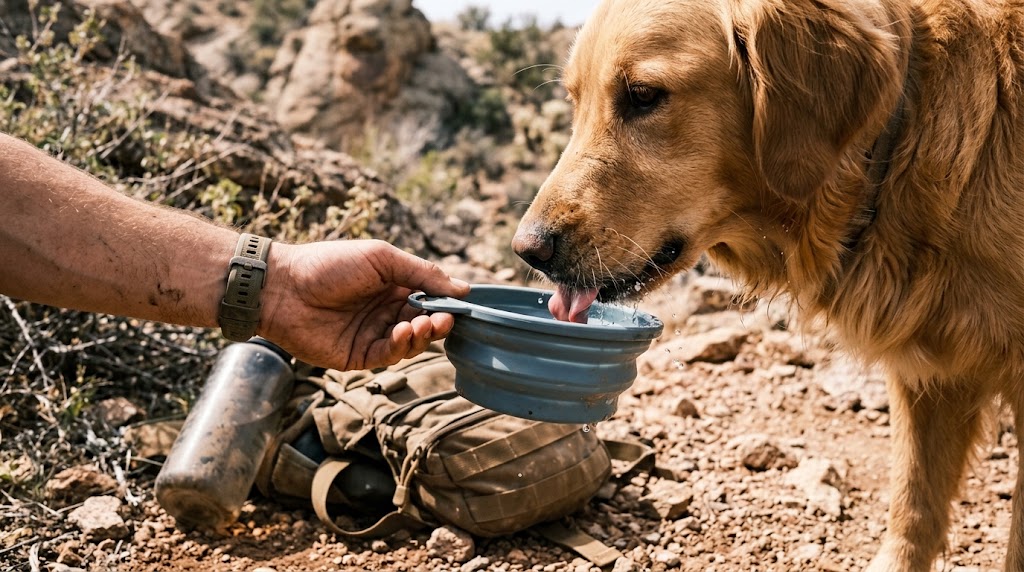
Dogs do not sweat through their skin. They dump heat by panting, which evaporates moisture from the tongue and respiratory tract at a startling rate. On a warm hike, a 30-kilogram dog can lose more than a liter of water per hour. Most owners underestimate this by half.
How much water does your dog actually need?
The standard veterinary guideline is roughly 50 to 70 milliliters of water per kilogram of body weight per day under normal conditions. But "normal conditions" means lying on the living room floor, not climbing a switchback trail in direct sun.
During moderate hiking, multiply the baseline by 2 to 3 times. During strenuous uphill work in heat, multiply by 3 to 4 times. Here is what that looks like in practice:
| Dog weight | Daily baseline | Moderate hike (3 to 4 hours) | Strenuous heat hike |
|---|---|---|---|
| 10 kg (22 lbs) | 500 to 700 ml | 1 to 1.5 liters | 1.5 to 2 liters |
| 25 kg (55 lbs) | 1.25 to 1.75 liters | 2.5 to 3.5 liters | 3.5 to 5 liters |
| 35 kg (77 lbs) | 1.75 to 2.5 liters | 3.5 to 5 liters | 5 to 7 liters |
Those numbers often surprise people. A 55-pound dog on a strenuous summer hike may need 4 liters of water. That is a kilogram of weight you need to carry if there are no reliable water sources on the trail.
Carry systems that actually work
For you to carry
A MalsiPree portable water bottle is built specifically for dogs. It has a flip-up trough and a one-button dispenser that lets your dog drink without you pouring water onto the ground. Undrunk water recycles back into the bottle. The 12-ounce size handles short breaks; for longer hikes, carry a larger water bladder in your pack and use the MalsiPree as the dispensing tool.
Collapsible bowls
Rest-Eazzzy collapsible silicone bowls clip onto your pack with a carabiner and weigh almost nothing. They work better than squeeze bottles when you are at a water source (stream, lake) and want to let your dog drink a full portion. The Ruffwear Trail Runner Bowl packs into its own pocket and holds a full liter, which is useful if your dog drinks slowly and you do not want to refill three times.
Reading dehydration before it becomes dangerous
Dogs do not tell you they are thirsty until they are already behind on fluids. Learn these three physical checks:
Skin tent test
Pinch the skin on the back of your dog's neck, lift it gently, and release. In a well-hydrated dog, the skin snaps back within one to two seconds. If it stays tented for three seconds or more, your dog is dehydrated.
Gum check
Press a finger against your dog's gum above the canine tooth. The spot should turn white, then return to pink within two seconds. If the pink takes longer to return, blood volume is low. This is called capillary refill time, and anything over three seconds on the trail means stop, water, and shade immediately.
Behavior changes
A dog that suddenly stops exploring, lies down in shade unprompted, or pants with a wide-open mouth and a spatula-shaped tongue is telling you something. These are late signs. Offer water every 15 to 20 minutes during hot hikes rather than waiting for visible distress.
Trail water sources: what is safe?
Dogs drink from streams and puddles without thinking. Most healthy adult dogs can handle moderate bacterial loads from moving water, but standing water, livestock ponds, and water downstream from developed areas carry higher risks of giardia and leptospirosis.
If you filter your own water on the trail, filter your dog's too. Alternatively, carry enough clean water for both of you and treat trail water as a backup.
Trail Bound Paws tip: Offer water before your dog asks for it. Set a timer on your watch for every 20 minutes and stop for a water break regardless of whether your dog looks thirsty. By the time a dog shows overt signs of thirst, they have already lost 3 to 5 percent of their body water.
For our full review of portable water gear, see the water safety and hydration gear guide.