 Trail Bound Paws
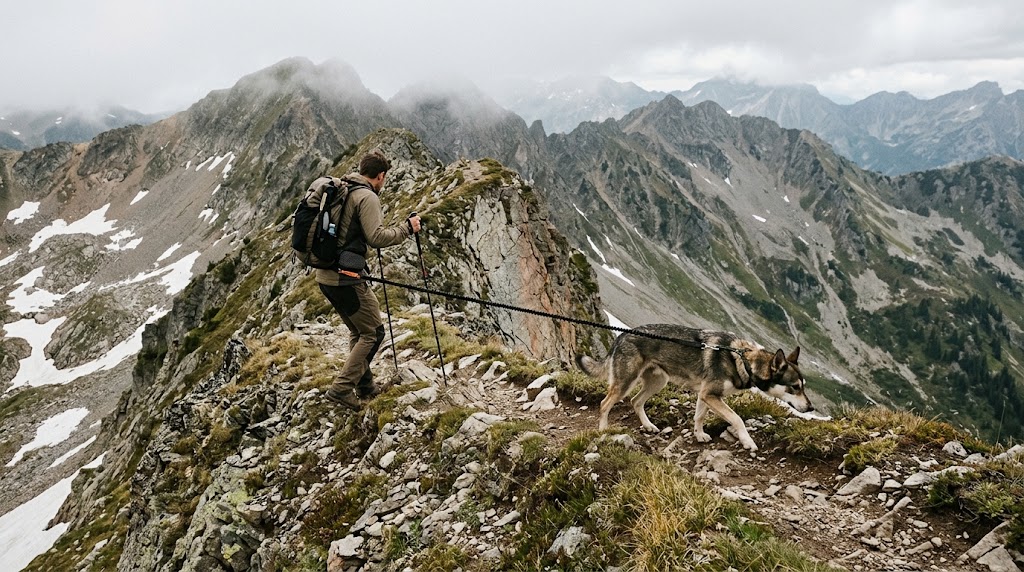
The physics of center-of-mass tethering
When you hold a standard leash in your hand, your arm functions as a dynamic, multi-joint suspension system. Your wrist, elbow, and shoulder flex and extend to absorb sudden pulls, and your grip acts as an immediate mechanical release: if you fall, you can drop the leash in a fraction of a second to protect yourself.
When you secure a leash to a waist belt, that dynamic suspension disappears:
- Direct kinetic transfer: Every sudden lunge, stop, or lateral pull transfers force directly into your lumbar spine and pelvis, your body's primary center of gravity.
- Loss of instant release: In a sudden slip or slide, you cannot instantly let go of the line unless the belt features an accessible, load-bearing quick-release buckle.
- Compounded falling mechanics: If a 60 lb dog accelerates toward a distraction, the dynamic peak force can easily match or exceed the handler's body weight, pivoting the human frame off its feet before footwork can compensate.
A properly designed harness is essential on the dog's end of this equation. A harness like the Ruffwear Front Range distributes forces across the sternum rather than concentrating them on the neck. See our trail harness guide for full evaluations.
Four backcountry scenarios where hands-free leashes are dangerous
1. Steep, loose descents (scree, mud, and wet rock)
On steep downhill grades, human balance is inherently precarious. Your braking muscles (quadriceps and calves) work at capacity, and your footing relies on friction against loose gravel, mud, or slick roots. If a dog surges ahead on a descent while tethered to your waist, the forward and downward vector pulls your pelvis forward, kicking your feet out from under you.
2. Technical scrambles and narrow shelf trails
Any terrain where a stumble results in a significant fall (exposed ridgelines, shelf trails, or boulder fields requiring three points of contact) makes hands-free tethering a critical liability. If your dog slips off an edge, a waist tether will drag you down with them. If you slip, the tether can pull the dog off balance. On tight switchbacks, an active dog can sweep the tether across your knees, tripping you mid-stride.
3. High-torque dogs without trail discipline
A hands-free leash is not a training device; it is a convenience tool for an already trail-trained dog.
- High prey-drive triggers: If a dog suddenly lunges at a marmot, deer, or snake, the handler has zero reaction time to brace. The sudden rotational torque on the lumbar spine can cause acute back strains or disc herniations.
- Asymmetric pulling: A dog that constantly drafts forward or darts from shoulder to shoulder applies continuous uneven torque to your sacroiliac joints and lower back, leading to severe trail fatigue over multi-mile treks.
4. Dense deadfall, thick brush, and narrow gates
When bushwhacking through blowdowns or navigating dense mountain laurel, a line tethered from your waist to your dog creates a taut tripwire. If the dog navigates around one side of a tree trunk while you step around the other, you are instantly locked in a mechanical clamp against the obstacle.
Quick-release hardware vs. static belts
Many consumer hands-free setups feature standard plastic side-squeeze buckles at the waist. While lightweight and cheap, plastic hardware fails under dynamic trail loads:
- Failure under load: Cheap plastic buckles can shear or crack when subjected to a sudden shock load from a large, lunging dog.
- Jamming under tension: When a dog is pulling hard, side-squeeze buckles pinch tight against the webbing, making them nearly impossible to release in an emergency.
If you hike in remote or rugged terrain, your waist belt must incorporate an accessible quick-release panic snap (similar to those used in ski joring or canine search-and-rescue) that can be triggered with one hand under full line tension. The BARKBAY No Pull Harness features a strong front-clip attachment point that gives handlers better control and redirection for dogs that tend to lunge.
Hands-free risk assessment
Use this checklist to decide whether hands-free tethering is appropriate for your trail route:
- Flat, rolling fire roads and gravel paths: Hands-free is safe. Use a medium bungee section to absorb gait pacing differences.
- Technical rocky climbs using trekking poles: Conditional. Safe on ascents with disciplined dogs, but must feature a quick-release emergency buckle.
- Steep descents on loose scree, ice, or wet clay: Not safe. Unclip from waist. Transition to a handheld leash with ample slack to manage footing independently.
- Exposed ridgelines or narrow cliff switchbacks: Not safe. Handheld control only. Shorten lead to 3 to 4 feet to keep dog locked at heel.
- Reactive dogs or wildlife-dense corridors: Not safe. Handheld two-point control (attaching to both front and back harness points).
The research verdict
Hands-free systems offer exceptional utility for sustained, low-consequence hiking and trail running where maintaining a fluid stride and using poles is paramount. However, they are not universal trail tools. The moment terrain becomes steep, footing turns slippery, or trail margins narrow, the safety priority shifts from convenience to mechanical separation. On demanding routes, a handheld leash remains the gold standard for immediate reaction time and fall safety.
Trail Bound Paws tip: If you prefer hands-free hiking on mixed terrain, look for a belt system with a one-hand quick-release buckle. Practice unclipping it at home until it becomes muscle memory. On the trail, switch to handheld control before you reach a technical section, not after you have already started descending.
To compare webbing configurations, load ratings, and ergonomic waist belts, explore our trail harness guide.