 Trail Bound Paws
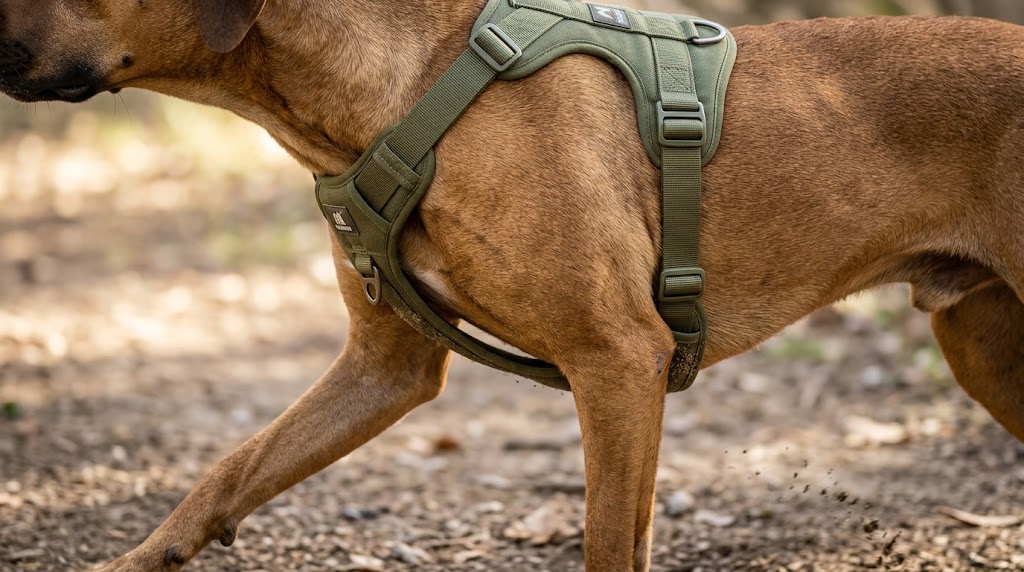
Three critical anatomical landmarks every handler must locate
Before tightening a single strap, locate three key structures on your dog's front assembly:
1. The scapulohumeral joint (point of the shoulder)
Feel along your dog's shoulder blade (scapula) down to where it meets the upper arm bone (humerus). The forward-facing protrusion is the point of the shoulder.
The rule: No strap should ever sit directly on or cross horizontally over this joint. When your dog reaches forward during an uphill climb, this joint opens wide; any webbing crossing it acts as a mechanical brake.
2. The manubrium (the sternum notch)
Slide your fingers down the front of the throat until you hit the top of the bony breastbone, the central, hard point projecting at the base of the neck.
The rule: In a Y-shaped harness, the central ring or junction of the front neck straps must rest directly on or slightly below the manubrium. If it sits too high, it presses into the trachea; if it sits too low, the neck straps will slip laterally across the shoulder blades and restrict joint movement.
3. The axillary zone (armpit clearance)
The crease directly behind the front elbow is thin, sensitive, and packed with delicate nerves and blood vessels.
The rule: The primary girth strap must never ride directly in the armpit fold. There must be enough clearance between the rear edge of the elbow and the girth strap to prevent constant friction rubs during repetitive movement. The Ruffwear Hi & Light is designed with generous elbow clearance specifically for this reason.
Step-by-step harness fitting protocol
- Center the neck opening: Slip the harness over the dog's head and pull the lower sternum plate into position along the center of the breastbone. Adjust the neck straps evenly so the Y-junction sits centered over the manubrium.
- Establish elbow clearance: Adjust the length of the lower chest piece running between the front legs along the belly. Aim for a clearance of two to four fingers (depending on the dog's size) between the back of the elbow and the girth strap when the dog stands squarely.
- Calibrate girth tension: Buckle the main girth strap around the ribcage. It should be snug enough that the harness cannot twist or roll laterally, but loose enough that you can smoothly slide two flat fingers between the webbing and the dog's coat.
- Conduct the dynamic gait check: Stand over your dog, lift one front leg by the paw, and gently extend it forward into a full stride reach. If the webbing pulls tight across the upper arm or yanks the entire harness forward into the throat, the neck opening is either too wide or the sternum strap is adjusted too short.
Sizing charts vs. deep-chested breeds
Most manufacturer size charts rely on two static measurements: neck circumference and girth circumference. What they often fail to capture is the distance between the sternum and the deep ribcage, creating fit problems for specific body types:
- Deep-chested, narrow-waisted dogs (sighthounds, boxers, pointers): The belly strap is often too short, pulling the main girth strap directly into the armpit crease. Select harnesses with an adjustable ventral strap length or a specialized long-frame design.
- Broad-chested, heavy-set dogs (bully breeds, mastiffs): The neck opening is often too narrow, forcing the Y-straps outward over the shoulder joints. Size up to clear the shoulder blades and cinch down the rear girth strap to maintain torso tension.
- Long-bodied, low-slung dogs (corgis, dachshunds): The overall frame is too long, causing the girth strap to sit past the floating ribs over the soft abdomen. Use compact Y-harnesses with short dorsal spines that keep the girth strap anchored over the true ribcage.
Four warning signs of a poorly fitted trail harness
- Shortened, stilted gait: If your dog takes abnormally rapid, choppy steps on flat trail sections instead of extending into a smooth, sweeping trot, the shoulder straps are likely impeding joint rotation.
- Refusal to climb steep grades: A harness that pinches the shoulder blades often feels manageable on flat ground but becomes uncomfortable the moment the dog needs to lift its forequarters over boulders or steep switchbacks.
- Persistent coat wear or fur thinning: Bald patches, flattened hair with red skin, or raw chafing behind the elbows mean the girth strap is adjusted too far forward.
- Harness rotation (crabbing): If the top handle or leash attachment continuously rolls over to one side of the spine while walking in a straight line, the neck straps are unevenly balanced or the sternum plate is too loose.
The BARKBAY No Pull Harness features multiple adjustment points that let you dial in the fit precisely, with a front clip for added control during the fitting process.
The research verdict
A hiking harness must act as an unobtrusive load-dispersion tool, never as an active restraint against natural canine motion. By prioritizing unimpeded shoulder joint rotation, proper manubrium placement, and generous elbow clearance, you protect your dog from joint wear and soft-tissue injury over thousands of trail miles.
Trail Bound Paws tip: After fitting a new harness, do a 20 to 30 minute walk on flat ground and then immediately inspect the skin under every strap. Pink or reddened skin means a pressure point is already forming. Adjust before your first real trail outing.
To compare harness models with multi-point strap adjustability and field-tested clearance dimensions, visit our trail harness guide.