 Trail Bound Paws
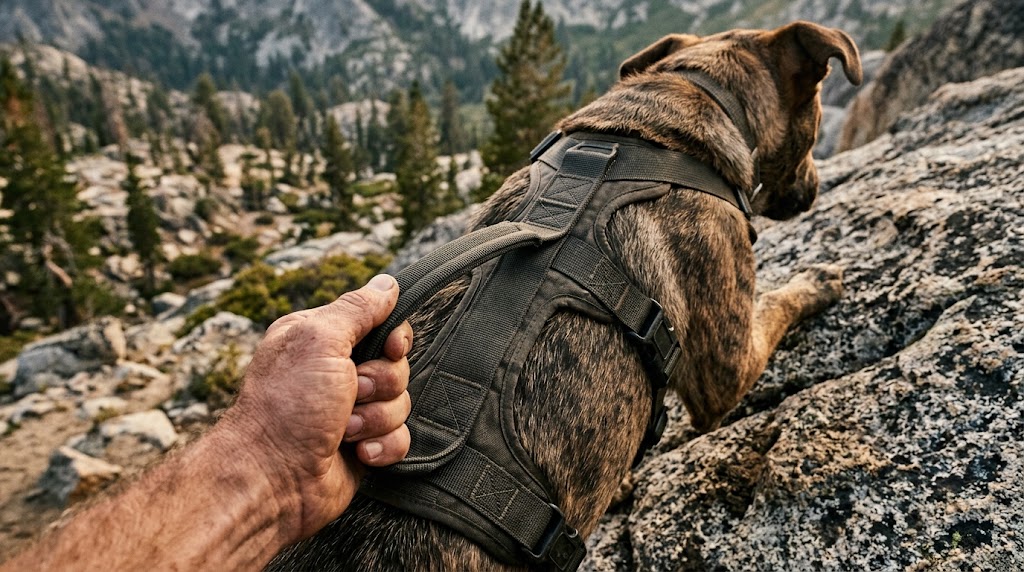
Three critical backcountry scenarios where a handle matters
A handle on a hiking harness is not intended to serve as a suitcase grip for carrying your dog over long distances. Instead, it serves three specific mechanical functions on the trail:
1. Assistance over trail obstacles
Backcountry trails routinely present obstacles that exceed a dog's comfortable jumping clearance: steep boulder scrambles, high fallen logs, slick riverbanks, and wooden stile crossovers. A sturdy handle allows you to provide upward lift and momentum assist, taking weight off the dog's joints without pulling on their neck or twisting their spine. On descents down slick rock, a handle enables you to counterbalance their weight, preventing forward tumbles and uncontrolled slides.
2. Immediate physical restraint at close quarters
Trail surprises happen: a sudden rattlesnake encounter, an unexpected mountain biker descending around a blind switchback, or wildlife encounters like deer or bears. Grabbing a leash allows a dog several feet of lunging distance, whereas reaching down and securing a rigid back handle provides immediate, zero-leverage mechanical control over the dog's center of mass, keeping them locked directly at your side.
3. Swift water and hazard extraction
If your dog slips into a swift mountain creek, gets stuck in a muddy bog, or loses footing on a narrow cliff path, reaching for a leash often pulls at an awkward angle. A balanced back handle acts as a direct anchor point, allowing you to lift or steady the dog out of immediate danger without choking them.
Assist handle vs. full-suspension harness
Many gear brands advertise "heavy-duty lift handles" alongside images of owners hoisting dogs into the air. There is a profound engineering difference between an assist handle and a full-hoist rated harness:
- Assist or balance handle: Webbing stitched into the dorsal plate, engineered for 20% to 40% weight assist. A single or dual chest and girth strap design. Good for obstacle momentum, balance assistance, and close-quarters restraint. Not safe for full dead-lift suspension.
- Full-suspension rigging harness: Continuous load-rated webbing that cradles the entire torso, with a primary girth strap, secondary rear belly support strap, and dedicated leg loops. Dynamic drop-tested with mountaineering-grade load ratings. Safe for 100% dead-lift and vertical extraction.
A harness like the Ruffwear Front Range includes a well-designed assist handle for obstacle work and restraint. For more extreme vertical scenarios, you would need a dedicated technical harness.
Static vs. dynamic weight distribution
When a 60 lb dog slips off a rock ledge, the dynamic shock load placed on the harness handle can easily double or triple the static weight. Standard hiking harnesses support assist forces (lifting 20% to 50% of the dog's body weight to boost them over a boulder). Lifting a dog completely off the ground by a single-girth harness concentrates all the upward force onto the lower ribs and diaphragm, which can cause severe bruising, soft-tissue injury, or respiratory restriction.
What to look for in a backcountry harness handle
- Orientation: Longitudinal (runs front to back along the spine) keeps the dog's body aligned with your forearm for stable lifting. Avoid transverse (side to side) handles that snag on brush.
- Stitching and reinforcement: Box-X reinforced bartack stitching integrated directly through the core webbing spine, not single-line stitching into a thin fabric panel.
- Profile and snag hazard: Low-profile, lie-flat, or semi-rigid contour that stays flush against the back until gripped.
- Grip clearance: Generous clearance allowing a full gloved hand to slide under quickly in an emergency. The Kurgo Tru-Fit is known for its sturdy, well-positioned handle with good glove clearance.
When a handle can be a liability
- Underbrush snags: If your dog runs off-leash through dense alpine scrub, thick briars, or heavy deadfall, an overly high-profile, upright handle acts as a hook. Choose a harness featuring an elasticized lay-flat handle or a semi-recessed strap.
- The "suitcase" misconception: Never use a standard handle to repeatedly swing or carry a dog like luggage. If a dog is fatigued, elderly, or injured and cannot support its own weight on the trail, a specialized dog carrying sling or backpack carrier is required for extended carry-outs.
The research verdict
If your hiking is limited to wide, flat paved paths, a handle is largely cosmetic. However, if your trail days involve elevation gain, slick river crossings, scrambles over deadfall, or narrow single-track trails, a low-profile, reinforced longitudinal handle is an essential piece of technical safety equipment. It turns your dog's harness into an active mobility and emergency restraint tool.
Trail Bound Paws tip: Test the handle at home before you hit the trail. Have your dog stand on a bathroom scale, grip the handle, and gently lift until you are supporting about a third of their weight. The harness should distribute the load evenly without pinching the chest or digging into the armpits. If it bunches or pulls the dog's body sideways, the strap geometry is wrong.
For detailed reviews of handles, tensile specs, and chest-plate biomechanics, explore our trail harness guide.