 Trail Bound Paws
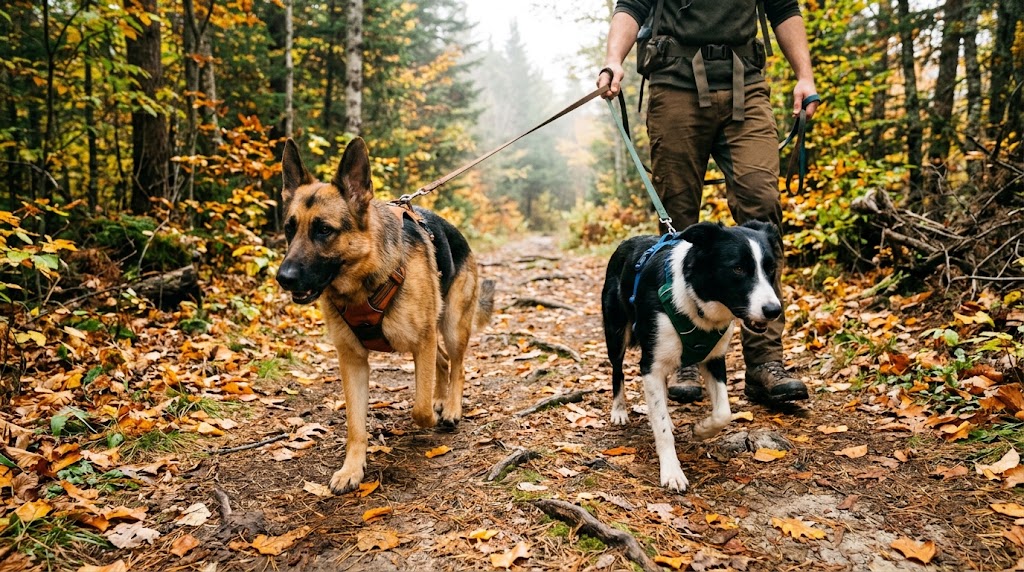
Hiking with one dog is a partnership. Hiking with two or more is logistics. The leash tangles, the pace conflicts, and the inter-dog dynamics that are invisible in your backyard all surface the moment the trail narrows.
Leash management: the core problem
Two dogs on separate leashes means two sets of decisions pulling in different directions. One stops to sniff while the other lunges ahead. Both leashes cross behind your legs on a switchback. You approach another hiker and need to pull both dogs to one side with hands that are already full.
The coupler solution
A leash coupler connects two dogs to a single handle point. This solves tangling but creates a new problem: the stronger dog controls the pace and direction for both. Use couplers only with dogs that are closely matched in size and energy level.
The waist leash solution
A hands-free bungee waist leash frees one hand for a second standard leash. Dog A connects to your waist, Dog B to your hand. This lets you manage them independently while keeping one hand available for balance, water bottles, or trail map checks. The bungee absorbs sudden pulls from the waist-attached dog so their lunges do not throw your balance on uneven terrain.
Pace conflicts
Every dog has a natural hiking pace, and two dogs rarely match. A young Lab wants to run ahead. An older Beagle wants to investigate every scent marker. Forcing both to walk at the same speed frustrates both of them.
Solutions:
- Let the slower dog set the pace. The faster dog gets exercise through mental work: practice recall, direction changes, and sit-stays at trail junctions.
- Hike with a partner. Two humans, two dogs, two leashes. Each person manages one dog and you can briefly separate at wider sections to let each dog move naturally.
- Use a dog backpack on the faster dog. A Ruffwear Approach Pack loaded to 10 to 15 percent of the faster dog's body weight adds just enough resistance to even out the pace. The slower dog walks normally while the packed dog works harder per step.
Inter-dog dynamics on the trail
Dogs that coexist peacefully at home can develop friction on the trail. Resources that do not exist at home (water sources, interesting wildlife smells, attention from other hikers) create novel competition opportunities.
Water access
Two dogs arriving at a stream crossing at the same time may guard the water. Let one dog drink while the other waits 10 feet away, then switch. Carry separate collapsible bowls so each dog gets their own water station during pack-water breaks.
Other dog encounters
Meeting an unfamiliar dog on the trail is more complex with two dogs on leash. Your dogs may react differently: one friendly, one reactive. Before the encounter, step off-trail, shorten both leashes, and position yourself between your dogs and the approaching dog. If either of your dogs is leash-reactive, do not attempt greetings. Move well off the trail, ask the other hiker to pass, and reward your dogs for calm behavior.
Rest stops
At rest breaks, give each dog their own space. Tie leashes to separate anchor points (trees, rocks) at least a leash-length apart. Dogs that are tired and slightly stressed from trail exertion are more likely to snap over personal space than they would at home on a lazy afternoon.
Gear checklist for multi-dog hiking
- One harness per dog (properly fitted to each individual)
- Separate water bowls (not shared)
- Individual waste bags clipped to each dog's harness or leash
- Separate treat pouches (feeding treats near each other can trigger resource guarding)
- A first aid kit stocked for your largest dog's needs
Trail Bound Paws tip: Do your first multi-dog hike on a wide, flat trail you already know well. Narrow singletrack with drop-offs and tight switchbacks is the worst environment to discover that your dogs tangle leashes on every bend. Start easy, work out the system, then add difficulty.
For harness recommendations that work well with multi-dog setups, see our trail harnesses and leashes guide.