 Trail Bound Paws
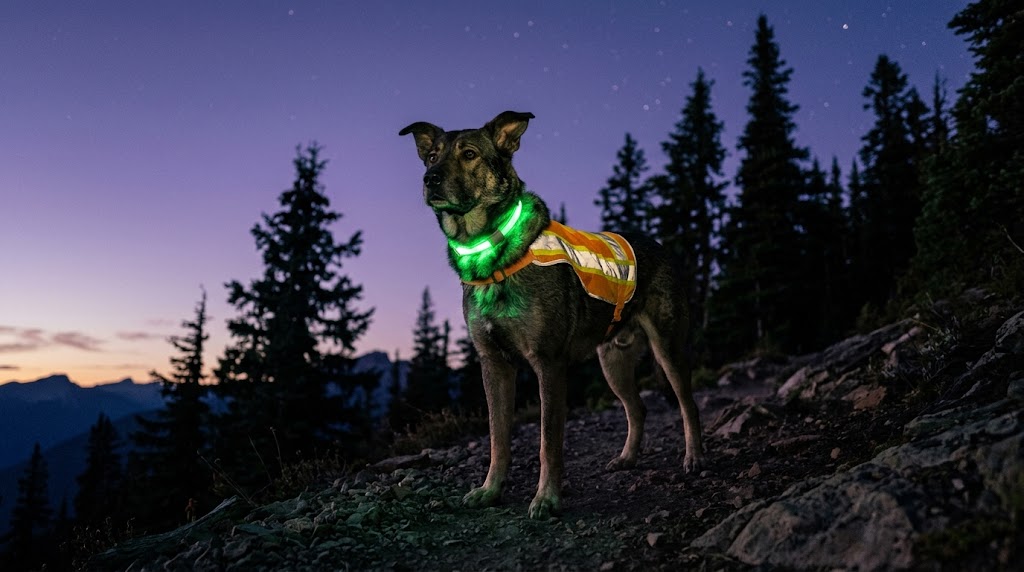
Dogs are nearly invisible to oncoming traffic, mountain bikers, and other hikers after sunset. A 60-pound dark-coated dog standing on a trail at dusk is functionally a shadow. Here is how to fix that.
How far away drivers and bikers can see your dog
An unlit dog on a road shoulder or trailhead parking lot is visible at roughly 20 to 30 feet under headlights. That gives a driver traveling at 25 mph about one second to react. A dog wearing an LED collar is visible at 1,000 feet or more. That is the difference between a swerve and a stop.
Mountain bikers on shared trails have even less reaction time because their headlamps illuminate a narrower cone. Reflective gear is good, but it only works when a light source is pointed directly at it. Active light (LEDs) works from every angle.
The three-layer visibility system
No single product covers every angle and scenario. Combine three types for full coverage.
Layer 1: Active LED light
An LED collar or collar light sits at your dog's natural height and moves with them, making it obvious that the light source is an animal, not a dropped headlamp. The Nite Ize Nite Dawg LED Collar wraps the entire neck with a continuous LED strip visible from 1,000 feet. It runs on a replaceable CR2032 battery and offers steady glow or flash modes.
Set it to steady glow on narrow trails where flashing could disorient other hikers, and flash mode near roads where maximum attention-grabbing matters.
Layer 2: 360-degree reflective gear
Reflective material bounces headlights and headlamps back to the source. The BARKBAY No Pull Harness has 3M reflective stitching on all straps, which means your dog reflects light from the front, sides, and top when wearing it. Unlike a simple reflective tag that only catches light from one angle, integrated reflective stitching covers the dog's full torso profile.
Layer 3: Reflective leash
Your leash is the visual connection between you and your dog. A full-length reflective bungee leash reflects light along its entire span, which helps approaching people judge the distance between you and your dog and avoid walking between you.
Common mistakes with night visibility gear
Relying on a single clip-on light
A blinking tag on a collar is visible from one direction. When your dog turns broadside, the tag faces sideways and its visibility drops to near zero. This is why collar-integrated LEDs outperform clip-ons: the light wraps around the neck and stays visible from every angle.
Using only reflective gear without active light
Reflective material requires an external light source aimed at it. On a dark trail with no approaching headlamps or headlights, your dog is invisible regardless of how much reflective tape they are wearing. Always pair reflective with at least one LED source.
Forgetting about yourself
If you are invisible, a driver or biker who spots your dog's LED collar still might not see you standing five feet away holding the leash. Wear a headlamp (even dimmed) and put a reflective strip on your pack.
When to avoid night hiking entirely
Visibility gear reduces risk on trails you know well. It does not make unfamiliar trails safe after dark. Cliff edges, unmarked mine shafts, and wildlife that is more active at night (coyotes, mountain lions, porcupines) all present risks that no amount of LED light solves. Stick to trails you have hiked in daylight, and keep your dog leashed. Off-leash dogs at night end up in confrontations with nocturnal wildlife at a much higher rate than leashed dogs, simply because they range further from the handler.
Trail Bound Paws tip: Test your dog's visibility gear in your backyard after dark before heading to a trail. Walk 50 feet away and see which parts of your dog are visible and which disappear. You will quickly spot gaps in coverage that are not obvious when fitting gear in a bright room.
For more on harnesses with built-in reflective features, see our trail harnesses and leashes guide.