 Trail Bound Paws
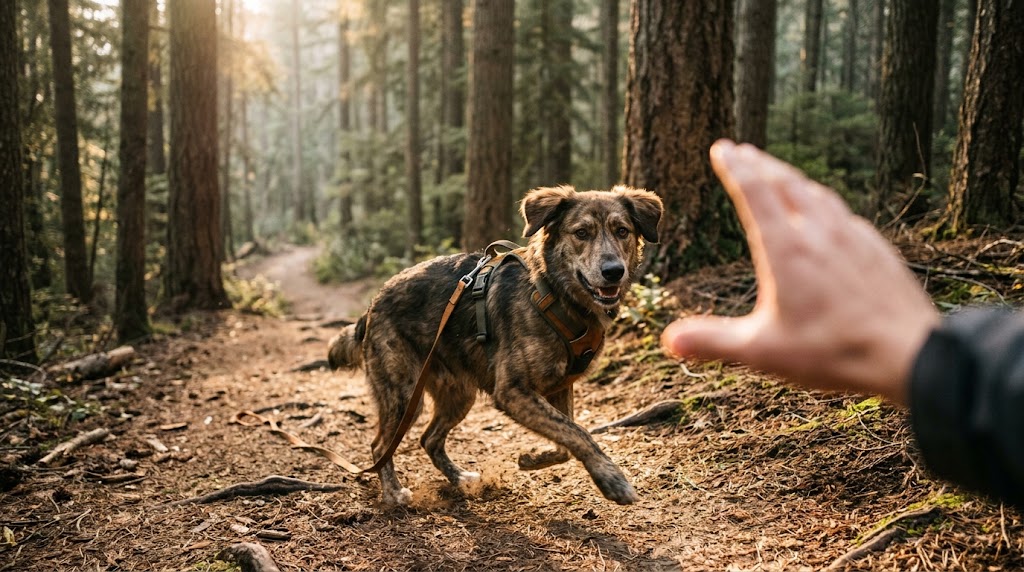
Reliable off-leash recall does not happen because your dog loves you. It happens because you built a reward history so strong that coming back to you beats whatever else is out there. Here is how to build that history systematically.
Before you start: be honest about your dog
Some dogs are better candidates for off-leash trail work than others. This is not a judgment on your training ability. Breed drives, individual temperament, and age all factor in.
Dogs with strong prey drive (huskies, many terriers, sighthounds) may never be reliably off-leash around wildlife. That is fine. A well-fitted harness and a long line give these dogs plenty of freedom without putting them or wildlife at risk. The Ruffwear Front Range Harness with a 7ft convertible rope leash works well for dogs that need physical connection without a tight heel.
Phase 1: Build the recall foundation at home
Start indoors, where distractions are close to zero. You need one specific word for recall. Pick something you do not use in everyday conversation. "Here" works better than "come," because you probably say "come on" casually twenty times a day and your dog has already learned to tune it out.
The 10-for-10 drill
- Stand three feet from your dog.
- Say your recall word once, in a normal tone.
- The instant your dog moves toward you, mark it with "yes" and deliver a high-value treat. High-value means something your dog does not get at any other time. Small pieces of freeze-dried liver, cheese, or hot dog work for most dogs.
- Repeat 10 times in a row, once a day, for 10 days.
After 10 days of this, your dog should whip around at the sound of the recall word even when facing away from you. If not, the treat is not high-value enough. Upgrade.
Phase 2: Add distance and mild distractions
Move to a fenced yard or a quiet park with a 30-foot long line attached to your dog's harness. The long line is your safety net, not a steering device. Let it drag on the ground.
- Wait until your dog is sniffing something moderately interesting (not a squirrel, just a patch of grass).
- Call the recall word once.
- If the dog comes, deliver the treat party: three to five treats in rapid succession, not just one. You want your dog to think "coming back to this person is the most profitable decision I make all day."
- If the dog ignores you, do not repeat the word. Walk calmly to the dog, gently take the long line, guide the dog back to where you were standing, and deliver a single treat. Then try again in five minutes with less distance.
Two rules during this phase: never call the recall word when you know the dog will not come (that erodes the word's meaning), and never punish a dog that comes to you slowly. Slow compliance is still compliance, and punishing it teaches your dog that returning to you has unpredictable consequences.
Phase 3: Trail-proof it
This is where most people rush and fail. Do not unhook the leash because your dog came back reliably in the backyard. Trails have deer, other dogs, ground squirrels, and smells your dog has never encountered. The long line stays on.
Start on quiet trails during off-peak hours. Practice recall at natural transition points: before trail junctions, before blind curves, and when you spot another hiker or dog in the distance. Every successful recall on the trail earns the treat party.
After 30 to 50 successful trail recalls on the long line with zero failures, you can start practicing with the line unclipped but still attached to the harness and dragging. This gives you a grab handle if something unexpected appears around a bend.
When to keep the leash on permanently
Off-leash is not a right. Some situations demand a physical connection regardless of training level:
- Trails with posted leash laws. Many national parks and protected areas require leashes to protect ground-nesting birds and sensitive habitats.
- Shared trails with horses. Even a well-trained dog approaching a horse at speed can cause a dangerous spook.
- Areas with cliff edges, mine shafts, or swift water.
- Any time your dog is recovering from illness or injury.
A shock-absorbing bungee leash gives a dog room to explore without the jarring pull of a fixed leash, which makes leashed hiking feel less restrictive for dogs used to more freedom.
Trail Bound Paws tip: Carry your recall treats in a separate pouch from your regular training treats. When the recall word means "come back and get the special food," it holds more weight than if recall treats are the same thing your dog gets for sitting at home.
For our full harness and leash recommendations for trail dogs, see the trail harnesses and leashes guide.