 Trail Bound Paws
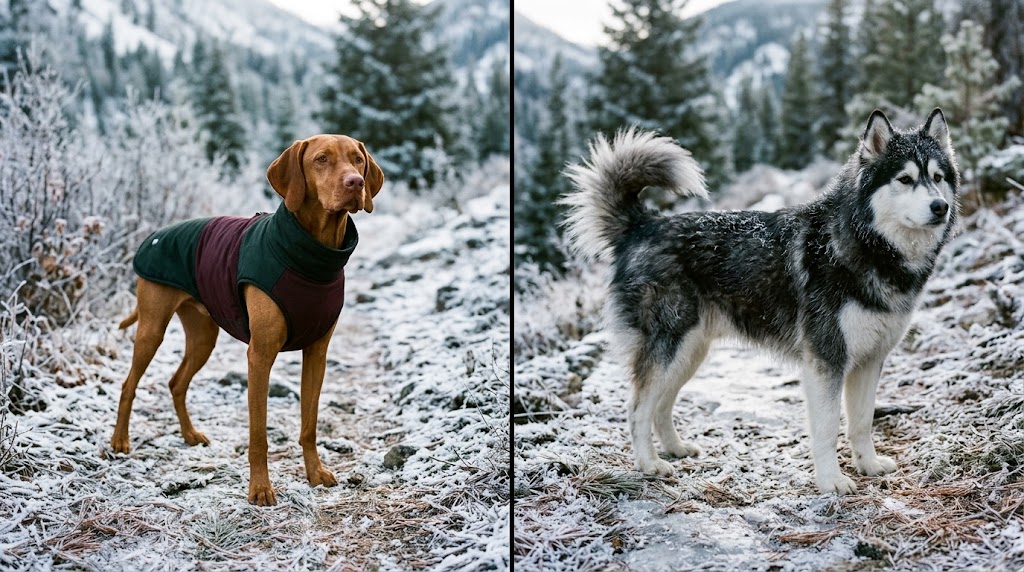
Anatomical comparison: single vs. double coats
A dog's thermal resistance depends heavily on whether their hair follicles produce a single layer of hair or a dual-layer thermal structure.
- Single-coated or short-haired breeds (vizslas, pointers, boxers, whippets): Single primary hair shaft per follicle. Negligible dead air loft. Typically very low body fat. Water hits the skin rapidly. High vulnerability to cold: rapid conductive and convective core heat loss below 5°C (41°F).
- Double-coated breeds (huskies, golden retrievers, german shepherds, border collies): Compound follicles with 10 to 20 fine, crimped undercoat fibers surrounding coarse guard hairs. Extremely high natural dead-air loft. Moderate to high fat reserves. Guard hairs deflect light precipitation, but once saturated, the undercoat retains water for 12+ hours. Low vulnerability to cold, engineered for sub-freezing weather down to -15°C (5°F) or lower.
Outfitting short-haired and single-coated dogs
Because single-coated dogs lack a built-in air cushion, their external clothing must fulfill both moisture management and core thermal insulation.
Critical heat loss zones
- The ventral torso (chest and sternum): Sparse hair coverage and major blood vessels. Garments that leave the chest and belly completely open provide minimal thermal benefit.
- Convective wind stripping: Cold backcountry winds cut directly through short fur, stripping away the thin layer of warmth.
- Caloric drain: Shivering consumes massive amounts of glucose. A cold, short-coated dog will rapidly burn through energy reserves, causing early trail fatigue.
Recommended layering strategy
- Dry sub-freezing trails (below 0°C / 32°F): Use a high-loft insulated winter coat featuring a wide, wrap-around chest plate and a windproof outer shell. Look for synthetic hollow-fiber fill that retains loft even under moderate humidity.
- Wet, chilly rain (2°C to 12°C / 36°F to 54°F): Use a taped-seam technical rain jacket with full belly protection. On near-freezing days, layer this over a thin, close-fitting synthetic stretch fleece.
- Brush and thorn defense: Short-haired dogs hunting or scrambling through brambles benefit from a rugged ripstop or 500D Cordura shell purely to prevent skin lacerations.
Underneath any outerwear, a slim-profile harness like the Ruffwear Front Range provides control without creating bulky layering conflicts.
Outfitting double-coated dogs: less is more
For double-coated breeds, outdoor clothing is frequently misused. These dogs already carry the biological equivalent of a high-loft down parka underneath a rugged canvas windbreaker.
The overheating hazard
Double-coated dogs generate significant metabolic heat during aerobic trail exercise. Placing an insulated or fleece-lined coat over a double coat compresses the natural air loft of their fur while preventing body heat from dissipating through normal convection. The dog can rapidly enter hyperthermia even when ambient temperatures sit near freezing.
The wet fur and matting dilemma
While double coats insulate exceptionally well against dry snow, they have an Achilles' heel: sustained cold rain. If rain penetrates past the outer guard hairs and saturates the dense underwool, the coat turns into a heavy, cold sponge. Trapped moisture combined with harness friction creates rapid coat matting and hot spots (acute moist dermatitis).
Recommended strategy for double coats
- Sub-freezing snow trails: No coat required. Their natural fur provides far superior thermal insulation and breathability than synthetic garments.
- Continuous driving rain (above 2°C / 36°F): Use an ultralight, uninsulated, seam-taped waterproof shell. Its sole job is keeping the guard hairs dry so the undercoat remains lofty. Ensure generous neck and tail venting. Pair with a harness like the Ruffwear Hi & Light for a low-bulk layering profile.
- Avoid all fleece linings: Never use fleece-lined garments on double-coated dogs. Fleece generates static electricity, rubs against guard hairs, causes severe undercoat friction knots, and traps excess heat.
Compression of natural fur loft
Clothing packaging frequently emphasizes heavy, thick fabrics and snug elastic straps. What manufacturers rarely mention is how tightly fitted apparel compresses hair fibers. Fur insulation is provided by the volume of dead air trapped between fibers, not the weight of the hair itself.
- Overly tight / compression fit on short-haired dogs: Prevents chafing but can pinch sensitive armpit folds and restrict shoulder reach.
- Overly tight / compression fit on double-coated dogs: Collapses natural undercoat loft, reducing the coat's built-in thermal value and ironically making the dog colder if the garment gets damp.
- Loose / relaxed fit on short-haired dogs: Allows cold air drafts to circulate beneath the coat, cutting thermal efficiency.
- Loose / relaxed fit on double-coated dogs: Preserves fur loft. Allows natural thermoregulation while deflecting external wind and rain.
Field selection matrix
- Warm rain (12°C to 20°C): No coat needed for either coat type. Towel dry at the vehicle.
- Cold rain / sleet (2°C to 10°C): Single coat: taped waterproof shell + chest plate. Double coat: unlined breathable rain cape only.
- Dry cold (0°C to -10°C): Single coat: full insulated winter parka. Double coat: no garment needed.
- Deep freeze (below -15°C): Single coat: full-body insulated snowsuit. Double coat: windbreaker shell only for high alpine exposure.
The research verdict
Outdoor dog clothing should always complement, not contradict, your dog's natural biology. For single-coated, short-haired dogs, apparel is a functional necessity in wet or sub-freezing weather. For double-coated breeds, apparel should be strictly limited to uninsulated, highly breathable waterproof shells during extended heavy downpours.
Trail Bound Paws tip: If you are unsure whether your dog is single- or double-coated, part the fur over the ribcage and look at the base. A single coat shows skin between sparse hairs. A double coat reveals a dense, soft, woolly layer underneath the longer outer guard hairs. This one check determines your entire outerwear strategy.
To compare waterproof membrane ratings, chest-plate dimensions, and harness attachment access, explore our weather protection guide.