 Trail Bound Paws
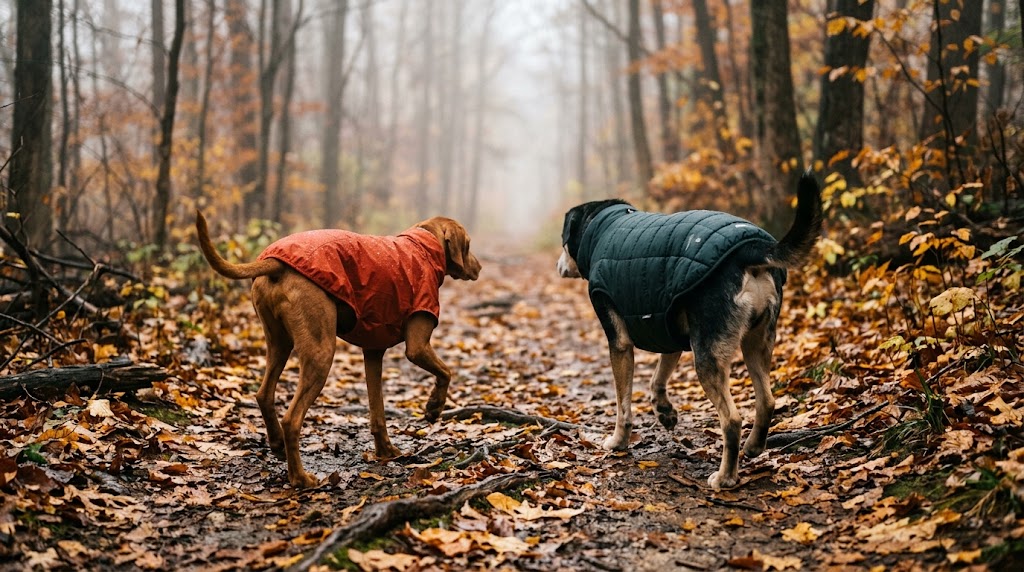
Technical comparison: rain shells vs. insulated coats
- Rain jacket (hardshell): An impermeable or semi-permeable moisture barrier. Zero to negligible thermal insulation. Rated 5,000 mm to 10,000+ mm hydrostatic head with taped seams. Best for high-exertion hiking, steep ascents, and sustained aerobic trotting. Primary target: continuous rain, wet brush, and sleet above freezing (above 2°C / 36°F).
- Insulated winter coat: High-loft synthetic or down insulation trapping dead air space. High thermal insulation. Water-resistant (DWR) to light snow but rarely fully stormproof. Best for low-to-moderate exertion, rest breaks, camp wear, or deep freeze. Primary target: sub-zero dry cold, packed snow, and high winds (below 0°C / 32°F).
The "wet-sponge" failure mode
Product descriptions frequently tout winter coats as "waterproof and warm." However, combining high-loft thermal insulation with non-taped outer fabrics introduces a major backcountry hazard.
- Taped rain shell: Heat-sealed seams prevent liquid ingress. Shell remains hydrophobic. Dog's natural undercoat stays dry, maintaining its natural loft. Weight remains static regardless of rainfall duration. Low hypothermia risk.
- Non-taped insulated coat: Standard needle stitching allows persistent driving rain to wick into internal batting. Wet synthetic batting collapses, and trapped liquid conducts heat away from the body 25 times faster than air. Can add 2 to 4 lbs of dead, cold weight to the dog's back. Critical hypothermia risk: creates a cold, wet compress locked directly over the spine and chest.
When to choose a rain jacket
An uninsulated rain jacket provides zero supplemental heat, relying on the dog's natural metabolic output and fur to maintain temperature.
- Wet trails above freezing (4°C to 18°C / 40°F to 65°F): Temperatures where added insulation would cause overheating, but continuous soaking compromises the dog's skin.
- Double-coated breeds in extended rain: Golden Retrievers, Huskies, and Australian Shepherds already have dense undercoats. Once saturated, their thick coats can take 12+ hours to dry, increasing the risk of acute moist dermatitis (hot spots). A rain shell keeps the guard hairs dry without causing heat stress.
- High-pace ascents and bushwhacking: Fast-moving trail dogs running uphill generate massive internal heat. A rain jacket shields the back from driving rain and mud while venting excess heat.
Regardless of outerwear choice, a well-fitted harness underneath is essential. The Ruffwear Front Range Harness fits cleanly under most rain shells without bunching at the shoulder.
When to choose an insulated coat
An insulated jacket functions like a human down or synthetic parka. Its sole objective is preventing conductive and convective heat loss to sub-freezing air.
- Dry, sub-freezing conditions (below 0°C / 32°F): Dry alpine environments, crusted snow trails, and biting wind.
- Single-coated and low-body-fat breeds: Whippets, Vizslas, Boxers, and Dobermans lack a dense insulating undercoat and store minimal subcutaneous fat. Without supplemental thermal loft, their bodies rapidly lose core temperature in cold weather.
- Camp rest breaks and stationary belays: When a dog transitions from a high-energy ascent to resting at a windy summit, its metabolic heat production drops instantly. An insulated coat during static breaks prevents muscle cramping and rapid heat loss.
Coat selection decision framework
- Heavy rain, 5°C to 15°C, single-coated dog: Uninsulated rain jacket with extended belly coverage.
- Heavy rain, 5°C to 15°C, double-coated dog: Ultralight unlined rain shell. Avoid all fleece linings to prevent overheating and coat matting.
- Near-freezing sleet (0°C to 3°C), single-coated dog: Layer a fully taped waterproof outer shell over a thin, non-absorbent synthetic fleece liner. The Kurgo Tru-Fit Harness has a slim profile that layers well under outerwear.
- Dry snow, -10°C to -2°C, single-coated dog: Insulated winter parka with high synthetic loft, deep chest plate, and windproof outer face fabric.
- Dry snow, -10°C to -2°C, double-coated working breed: None required, or wind shell only. Their biological undercoat provides superior insulation; garments often cause heat fatigue.
The research verdict
The fundamental distinction between rain shells and insulated coats is water management versus thermal trapping. Never use an insulated winter coat in driving rain unless the outer fabric has heat-taped seams and certified hydrostatic waterproof ratings.
For multi-season trail use, the most adaptable setup is a modular layering system: an uninsulated, seam-taped waterproof shell that can be worn alone during wet summer and fall hikes, or layered over a fitted thermal base fleece when winter conditions demand both moisture defense and core warmth.
Trail Bound Paws tip: Before heading out in cold rain, pour a cup of water onto your dog's jacket and watch what happens. If the water beads and rolls off, the DWR (durable water repellent) finish is working. If it soaks in, the jacket needs reproofing or it is the wrong garment for the conditions.
To compare waterproof ratings, seam construction, and anatomical harness-port integration, visit our weather protection guide.