 Trail Bound Paws
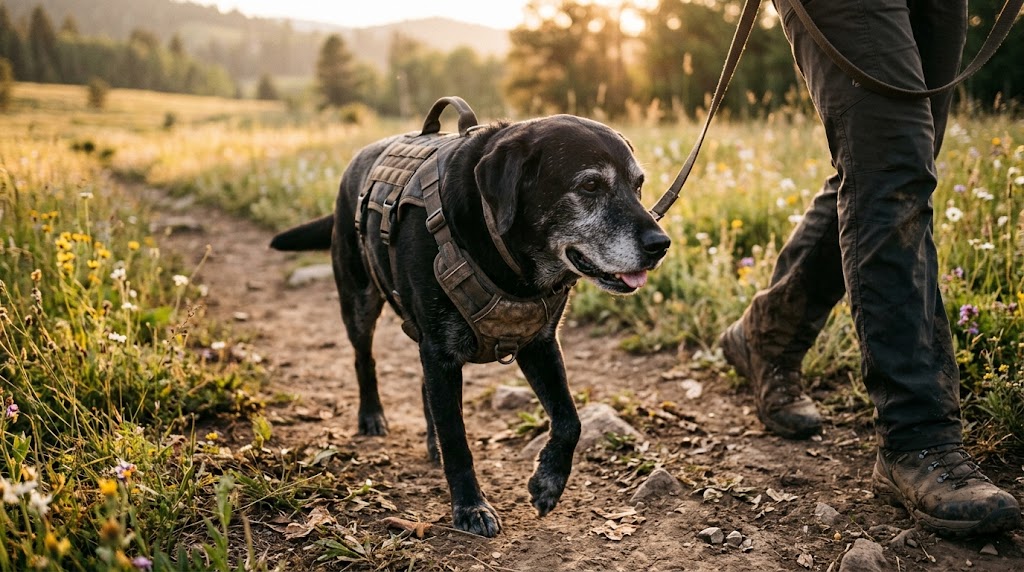
Your dog does not retire from hiking because they turn eight. But the hike needs to change. Joint stiffness, reduced stamina, and slower heat regulation mean the trails and pace that worked at age three can cause real harm at age ten.
What changes in an aging trail dog
Joint wear and arthritis
Canine osteoarthritis affects an estimated 20 percent of dogs over age one and up to 80 percent of dogs over age eight, according to veterinary orthopedic research. The cartilage cushioning joints in the hips, elbows, stifles, and spine thins over time. The result is stiffness after rest, reluctance to jump, and a slower gait on uneven ground.
You will notice this most on descents. Going downhill loads the front limbs with two to three times the dog's body weight at each step. A dog that used to bound down switchbacks will start placing each front paw deliberately, slowing down, or sitting mid-slope. This is not stubbornness. It is pain management.
Reduced cardiovascular reserve
Older dogs reach their aerobic limit faster and recover more slowly. A five-minute rest break that fully recharged your dog at age four may take fifteen minutes at age ten. Heart rate stays elevated longer after steep climbs.
Temperature sensitivity
Senior dogs regulate body temperature less efficiently in both heat and cold. They overheat faster on summer trails and lose body heat faster on cold, windy ridgelines. The margin between comfortable and dangerous narrows with age.
Adapting your trails
The goal is to keep hiking, not to stop. These modifications let you do that safely.
Distance and elevation
Cut your standard distance by a third and your elevation gain by half as a starting point. Watch your dog's energy level across three to four adjusted hikes. If they finish strong and want more, add back distance gradually. If they are stiff the morning after, you went too far.
Surface matters more now
A packed dirt trail is significantly easier on arthritic joints than rocky scree or paved roads. Avoid trails with sustained boulder fields, tall step-ups, or long staircase sections. Flat to rolling forest trails with soft soil are ideal.
Timing
Hike early morning or late afternoon to avoid peak heat. Senior dogs also benefit from a 10 to 15 minute warm-up walk on flat ground before hitting any incline. Cold-starting an arthritic joint uphill is like running a race without stretching.
Gear changes for senior dogs
Harness: switch to lightweight
Heavy tactical harnesses add load to already-stressed joints. The Ruffwear Hi & Light Harness weighs roughly half of a standard trail harness. Its single-layer mesh reduces bulk, and the Y-shaped chest piece avoids pressure on the shoulder joints. The back handle lets you assist your dog over obstacles without lifting under the belly, which can be painful for dogs with spinal issues.
Car access: use a ramp
Jumping in and out of an SUV or truck bed is one of the worst repetitive impacts on an older dog's joints. A PetSafe folding ramp removes the jump entirely. Use it every time, not just when your dog hesitates. By the time a dog refuses to jump, the joint damage that makes jumping painful has been accumulating for months.
Rest and recovery gear
On overnight trips, a Ruffwear Highlands Pad insulates your dog from cold ground and provides cushioning for sore joints. Paired with the Ruffwear Highlands Sleeping Bag, it keeps an older dog warm through the night without relying on body heat alone, which senior dogs generate less efficiently.
Warning signs to stop the hike
Mild slowing is normal and expected. These signs mean turn around immediately:
- Bunny hopping on descents: Both rear legs moving together instead of alternating. This indicates hip or lower-back pain severe enough to alter gait.
- Persistent panting after five minutes of rest: An older dog that cannot recover normal breathing within a few minutes may be in cardiovascular distress, not just winded.
- Sudden refusal to move: Not stopping to sniff, but planting and refusing to walk. This is usually acute pain in a limb or the spine.
- Knuckling: The top of the paw dragging on the ground instead of the pad. This signals neurological issues in the spine (often degenerative myelopathy) and requires a vet visit, not a rest break.
Trail Bound Paws tip: Keep a trail log for your senior dog. Note the distance, elevation, temperature, and how your dog moved the next morning. After five or six entries, you will have a clear picture of their current limits rather than guessing based on what they used to handle.
For lightweight harness options and vehicle access gear, see our trail harnesses guide and car travel gear guide.