 Trail Bound Paws
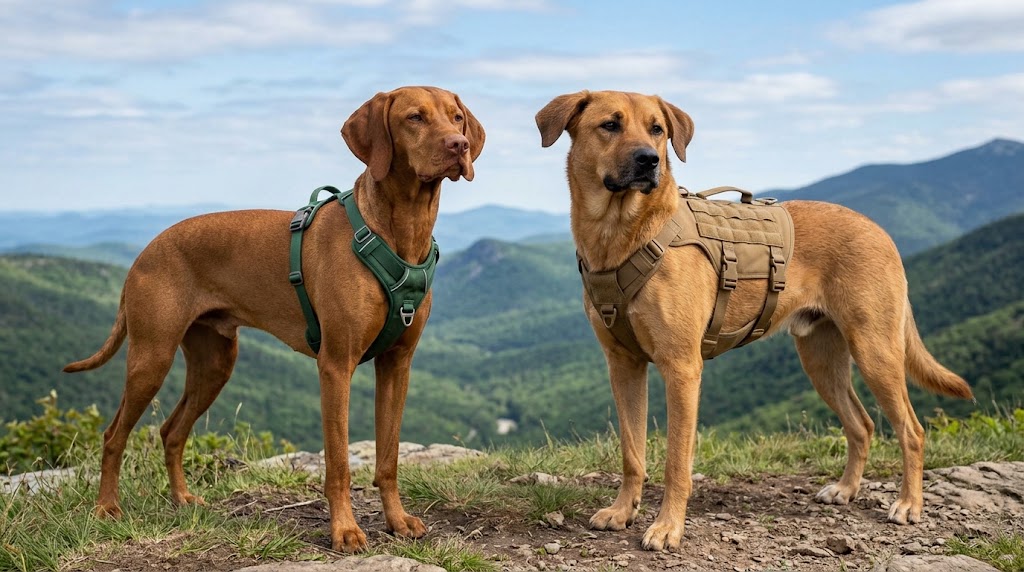
The canine shoulder: why freedom of motion matters
Unlike human shoulders, which are anchored to the skeleton via clavicles, a dog's forelimbs are attached to the torso entirely by muscle, tendon, and connective tissue (a system called synsarcosis). When a dog extends its front leg forward while hiking uphill:
- The scapula (shoulder blade) rotates forward and upward.
- The scapulohumeral joint (shoulder joint) opens to extend the humerus.
- The front leg swings forward in an unimpeded arc to plant the paw cleanly.
If an equipment strap wraps horizontally across the front of the chest, it rests directly over the point of the shoulder and across the biceps tendon. Every time the dog reaches forward, the limb collides with the strap, shortening the stride, increasing friction across soft tissue, and forcing abnormal compensatory movement through the spine.
If you are looking for our top researched models, head straight to our complete trail harness guide.
Y-shaped harnesses: biomechanics and field performance
A Y-shaped harness features a central chest plate or webbing strip that runs down the center of the sternum (breastbone), connecting to two straps that wrap up and around the dog's neck, joining at the withers to form a distinct "Y" shape when viewed from the front.
Mechanical advantages
- Zero scapular restriction: The neck straps rest high above the shoulder joint, clearing the spine of the scapula and the upper humerus. This allows full, natural front-limb extension during steep climbs and descents.
- Sternum load bearing: Pulling forces are distributed along the sternum, the strongest, most stable bony structure on a dog's ventral torso, rather than the soft tissues of the throat or the delicate shoulder joints.
- Axillary (armpit) clearance: Well-designed Y-harnesses position the main girth strap several inches behind the elbow, preventing painful chafing in the sensitive axillary region on long treks.
A harness like the Ruffwear Front Range exemplifies this design, with a Y-shaped chest piece that clears the shoulders while distributing force along the sternum.
Technical limitations
- Rotational instability on asymmetric dogs: Because Y-harnesses use narrow straps to maximize leg freedom, poorly fitted models can roll laterally across the ribcage if a leash is pulled sharply from the side.
- Less restraint for reactive dogs: An open-front design allows full drive and propulsion; handlers working with severe pullers cannot rely on mechanical leverage to turn the dog's shoulders.
Vest-style harnesses: control vs. kinematic compromise
Vest-style harnesses typically feature wide fabric panels that wrap around the chest and torso, or a straight horizontal strap that cuts directly across the front of the chest from shoulder to shoulder.
Mechanical advantages
- Surface pressure dispersion: Broad fabric panels distribute static loads over a larger surface area, which helps when momentarily stabilizing a dog on flat ground.
- Escape resistance: The extensive fabric coverage and wrap-around cut make it harder for deep-chested, narrow-waisted dogs (like sighthounds) to back out of the harness.
- Tactical attachment real estate: The large solid body panels provide ample mounting area for MOLLE webbing, identification patches, and gear pouches.
Technical limitations on the trail
- Restricted shoulder extension: Horizontal chest bands act like a tourniquet across the front limbs. Veterinary gait analyses consistently show that horizontal chest straps restrict forelimb extension, reducing stride length and altering the natural gait.
- Heat trapping: Large fabric vests cover the dog's back and ribs, trapping body heat during warm-weather hikes and interfering with natural convection cooling.
- Underarm rubbing: Many vest designs place the primary girth strap directly in the crease behind the front leg, creating severe friction and skin abrasions on multi-mile hikes.
Gait kinematics and long-distance impact
Harness packaging frequently advertises terms like "ergonomic," "all-day comfort," and "total control." Here is what the technical documentation often leaves out:
- Forelimb extension on incline: Y-shaped harnesses leave the stride unrestricted. Vest-style horizontal bands shorten the reach of the humerus, forcing a choppy, high-stepping stride. For natural uphill climbing mechanics, Y-shaped wins.
- Thermal convection and heat dissipation: Y-shaped harnesses have minimal contact area, leaving the torso exposed for natural temperature regulation. Heavy Cordura or neoprene vest panels trap ambient heat across the back and ribs. For warm-weather and high-output trails, Y-shaped is vastly superior.
- Pull-force distribution: Y-shaped transfers force safely onto the bony sternum and ribcage. Vest-style transfers force horizontally across the scapulohumeral joints and upper arms, risking chronic repetitive stress on front shoulder tendons.
- Escape resistance: Vest-style is advantageous only for severe escape artists in low-intensity settings, thanks to broad wraps covering more surface area.
The verdict for trail handlers
For backcountry hiking, hill climbing, and long-distance trekking, the Y-shaped harness is the clear winner. Preserving free joint articulation is vital when a dog is navigating boulders, negotiating tree roots, and climbing steep elevation changes. A horizontal strap or restrictive vest forces the dog to compensate with its spine and rear legs, leading to premature fatigue and potential joint wear over time.
Reserve vest-style designs for short, low-intensity neighborhood walks where extreme pull-deterrence is mandatory, or vehicle travel where crash-force distribution across a wider area takes precedence over limb mobility.
For ultralight trail situations where every gram matters, the Ruffwear Hi & Light delivers the Y-shaped biomechanical advantages in a minimal-weight package.
Trail Bound Paws tip: To check if a harness restricts your dog's shoulders, have them walk uphill on leash. Watch the front legs from behind. If the stride looks choppy or shortened compared to off-leash movement, the chest strap is sitting too low across the shoulder joint.
To find models engineered with deep-cut sternum plates, generous elbow clearance, and durable hardware, visit our complete trail harness guide.