 Trail Bound Paws
The general baseline: percentage of body weight
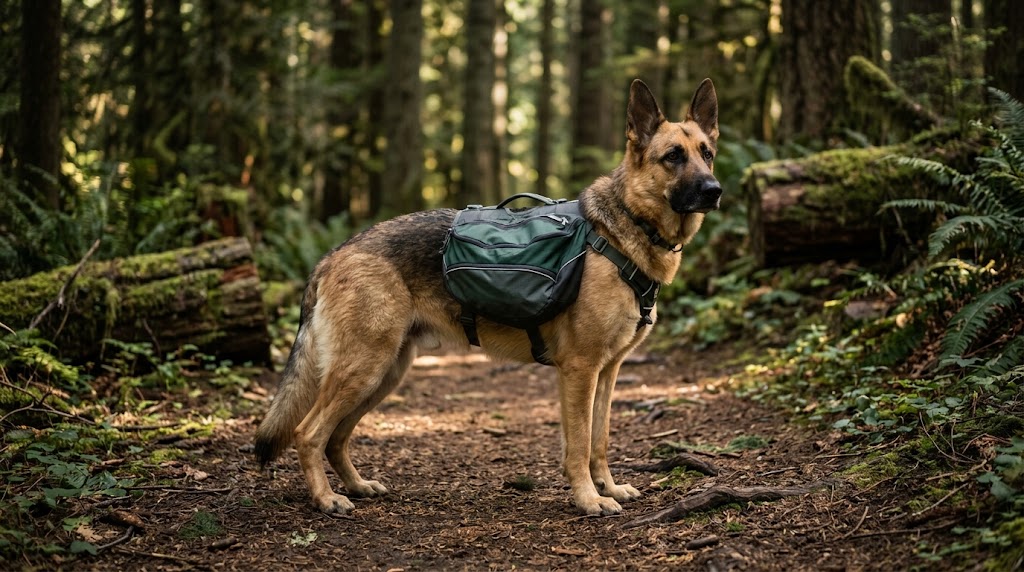
A standard guideline frequently cited in the outdoor gear market says a healthy dog can carry between 10% and 25% of their total body weight. From an orthopedic perspective, treating 25% as a general target is dangerous. Veterinary consensus views 25% as an absolute ceiling reserved strictly for fully conditioned, prime-age working breeds (such as Siberian Huskies, Alaskan Malamutes, or German Shepherds) hiking on flat, moderate terrain in cool weather.
For the vast majority of companion trail dogs, load capacity should follow a conservative tiered framework:
- Introductory / conditioning phase (0% to 5%): First 4 to 6 weeks of trail training. Empty pack or light bulk like foam and poop bags only. Building spatial awareness around trees and rocks.
- Standard day-hiker baseline (10% to 12%): Rolling trails, moderate elevation changes, distances up to 8 to 10 miles. For a 60 lb dog, that means 6.0 to 7.2 lbs total including the pack itself.
- Conditioned backcountry athlete (15% to 18%): Sound adult working or sporting breeds on maintained multi-day wilderness trails.
- Veterinary maximum ceiling (20% to 25%): Peak athletic condition; cool weather only; flat terrain; never sustained long-term.
Crucial rule: The total calculated weight must include the dry weight of the backpack itself. Sturdy, feature-rich saddlebag chassis can weigh anywhere from 1.0 to 2.5 lbs completely empty. A pack like the Ruffwear Approach Pack keeps its own weight low while providing solid weight distribution. See our dog backpacks guide for full comparisons.
Five biological factors that override the percentage rule
1. Skeletal maturity and growth plates
Under 18 to 24 months: Never place structural weight on a young dog. In large and giant breeds, long-bone growth plates do not fully ossify and fuse until 18 to 24 months of age. Subjecting immature joints to compressive vertical loads can cause irreversible developmental abnormalities, including hip dysplasia, elbow dysplasia, and angular limb deformities. Young dogs may wear an empty pack purely for habituation.
Senior dogs (7+ years depending on breed): Degenerative joint disease, subclinical arthritis, and spondylosis of the spine are common in older dogs. Even a 10% load can aggravate chronic inflammation.
2. Spinal conformation and body proportions
- Long-backed breeds (dachshunds, corgis, bassets): Elongated lumbar spans unsupported by the pelvic girdle. They should never carry backpacks. Downward compressive loads exponentially increase the risk of Intervertebral Disc Disease (IVDD).
- Deep-chested, narrow-waisted breeds (pointers, boxers, weimaraners): Carry weight well over their forward ribcage, but packs easily slide forward into their neck if girth straps lack stability.
- Square-proportioned breeds (working retrievers, shepherds, sled dogs): Compact, balanced torsos feature the strongest natural spinal bridging for pack distribution.
3. Ambient heat and hydration dynamics
Carrying saddlebags significantly increases energy expenditure and metabolic heat production. Broad fabric panniers act like heavy insulating blankets over the dog's ribcage and back, preventing convective cooling. On warm or humid days, reduce pack weight by at least 50%, or remove the saddlebags entirely to prevent heat exhaustion.
4. Trail terrain and elevation grade
A 10-lb pack that feels manageable on flat dirt becomes punishing when scrambling up 25-degree talus switchbacks or jumping down off ledges. Downward leaps multiply the impact force on front shoulders and carpal joints by up to four times the dog's resting weight. On steep or technical scrambles, handlers should carry the weight.
5. Water weight fluctuations
Water is dense and heavy: 1 liter weighs approximately 2.21 lbs. If you pack two 1-liter soft bladders into your dog's panniers, that alone accounts for 4.4 lbs of dynamic load. We analyze fluid-shift dynamics and balance risks in our dedicated guide on whether your dog should carry its own water.
Forward shoulder loading vs. pelvic sag
Backpack marketing photos often show sleek, centered saddlebags positioned midway along the dog's spine. From a biomechanical perspective, this is the worst place to locate weight.
- Incorrect: centered or rearward loading. Centered over the mid-back, extending across the loin toward the pelvis. Forces the spine to sag (lordosis), compresses discs, and destabilizes the hindquarters.
- Correct: forward scapular loading. Biased forward directly over the withers and forward ribcage. Transfers downward force through the front limbs, keeping the spine and rear hips unweighted. The Kurgo Big Baxter Backpack positions its saddlebags forward over the ribcage for exactly this reason.
The key takeaway: when fitting a dog pack, the bulk of the weight must sit directly over the dog's shoulders and forward ribs, never back across the loins or lower spine.
Four signs your dog's backpack is overloaded
- Reluctance to move or "pacing": Instead of a smooth, alternating trot, an overloaded dog often switches to an unnatural lateral pace (moving both legs on the same side forward simultaneously) to stabilize excessive downward weight.
- Frequent sitting on level ground: If your dog abruptly sits or lies down every time the hiking group stops for a 30-second water break, the pack is too heavy.
- Sagging spine or dropped tail: A noticeable downward dip in the topline indicates that the dorsal muscles are fatiguing and failing to support the lumbar spine against the load.
- Stumbling on minor roots and rocks: Excess weight blunts proprioceptive reaction time. If a normally surefooted dog is scuffing its paws or catching toes on trail obstacles, remove the weight immediately.
The research verdict
Canine trail backpacks are exceptional tools for conditioning and mental stimulation, provided they are managed with discipline. For the average adult, healthy trail dog, keep total pack weight between 10% and 12% of their body weight. Reserve higher thresholds strictly for fully mature, conditioned working breeds on cool, level terrain, and always position the bulk over the forward ribcage.
Trail Bound Paws tip: Weigh the loaded pack on a kitchen scale before every hike. It is easy to creep past safe limits when you add "just one more" water bottle or bag of treats. Weigh once, decide once, and leave the excess in the car.
To find packs engineered with forward-weight bias and ergonomic chest cradles, visit our dog backpacks guide.