 Trail Bound Paws
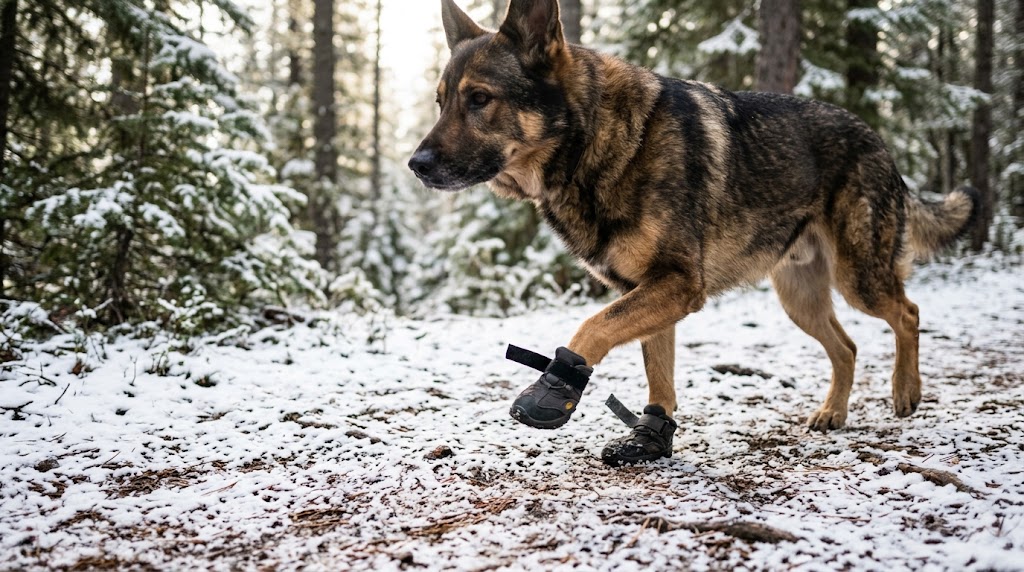
The canine anatomy problem
Human feet are essentially L-shaped, providing a built-in shelf (the heel and ankle) that prevents a tied shoe from sliding off. Dogs are digitigrades, meaning they walk on their toes. Their lower leg anatomy creates a significant design challenge for boot manufacturers:
- The tapered carpus: A dog's lower leg tapers downward toward the paw without a pronounced ankle shelf to anchor a strap.
- Dewclaw interference: The dewclaw sits exactly where most boot closure straps need to cinch tightly, creating a primary friction point.
- Dynamic splay: A dog's paw expands significantly in width when bearing weight and contracts when lifted.
If you are looking for our top researched models and sizing breakdowns, you can jump directly to our complete paw protection and dog boots guide. If you want to understand why your dog's boots keep flying off and how to permanently fix the issue, read on.
What the specs don't tell you: sole rigidity vs. closure shear force
When evaluating gear, many owners assume that a thicker, stiffer sole equals a better boot. However, highly rigid outsoles are the primary reason dog boots fall off.
When a dog walks, its paw naturally flexes. If the rubber outsole of the boot is too stiff to flex with the paw, the mechanical force of the dog's step levers the heel of the boot downward. This creates massive vertical shear force against the hook-and-loop closure strap. Because the dog's leg is tapered, the strap inevitably loses the battle, sliding down the leg and allowing the boot to pop off.
Are expensive dog boots worth the extra cost? Yes, but only if that cost goes toward advanced materials that offer high puncture resistance without sacrificing sole flexibility. A thinner, highly flexible, puncture-resistant sole will stay on the foot far better than a thick, rigid hiking tread. Boots like the QUMY Dog Boots use a flexible rubber sole design that moves with the paw rather than against it.
Three steps to a secure fit
1. Measure at maximum splay
The most common sizing mistake is measuring the paw while the dog is lying down or standing casually. A paw expands horizontally when fully loaded.
How to do it: Have your dog stand on a piece of paper. Gently press down on their back or shoulders to force them to bear full weight on the paw. Mark the widest points on the paper and measure the distance. If your dog is between sizes, size down slightly for boots with flexible uppers, or size up if using boot liners.
2. Manage the dewclaw
If your dog has front dewclaws, wrapping a boot strap directly over them will cause pain and loosening.
The solution: Wrap the lower leg and dewclaw with a layer of cohesive flexible bandage (vet wrap) before putting the boot on, or use specialized canine boot liners (which look like small socks). This creates a uniform surface for the boot strap to grip and eliminates friction sores.
3. The two-strap advantage
For high-intensity trails, look for boots utilizing a dual-strap closure system. A secondary strap positioned slightly higher on the carpus distributes the shear force and anchors the boot above the initial taper of the lower leg. The HiPaw Summer Breathable Dog Boots feature this kind of secure dual-closure design.
When to leave the boots behind
If you are fighting a losing battle with boot fit on a moderate trail, your dog might not need them. For packed snow, short urban walks, or basic paw conditioning, topical barriers are often more effective and eliminate the fit problem entirely. We break down the physics of ointments versus footwear in our guide on dog boots vs. paw wax.
Trail Bound Paws tip: Before your first trail outing, do three to five short practice walks on pavement with new boots. This lets your dog adapt to the altered gait and gives you time to adjust strap tension before the stakes are higher on uneven terrain.
To find the right balance of flexibility, closure security, and terrain protection for your next hike, review our top-rated technical picks in the paw protection and dog boots guide.